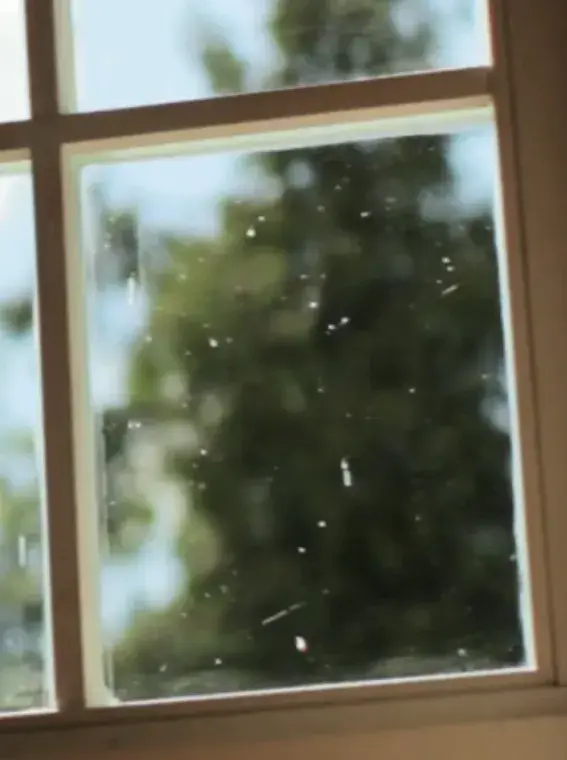
Hard Water Spots on Windows — Can They Be Removed?
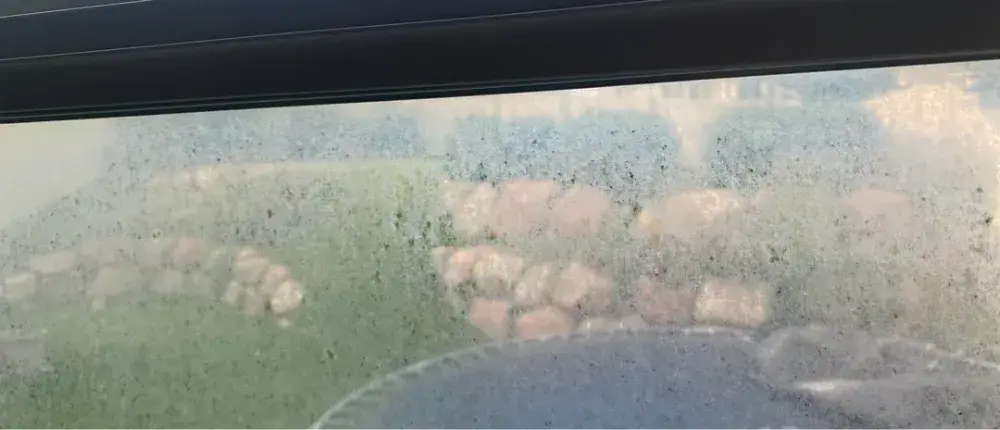
In most cases, yes — but whether they come off completely depends on how long they’ve been on the glass and how far through the bonding process they’ve progressed. Fresh deposits respond to professional cleaning on the first visit. Calcium that has bonded to the glass surface over multiple irrigation seasons may need a separate treatment. Calcium that has etched into the silica doesn’t come off at all.
The white spots on your windows are calcium carbonate — dissolved calcium from San Clemente’s hard water supply that dried on the glass surface and left its mineral content behind. Every irrigation cycle deposits a fresh layer. At 625 ppm TDS, San Clemente’s tap water is in the very hard classification, and the rate at which calcium builds on irrigation-adjacent glass here is faster than most of California. Here’s exactly what you’re dealing with and what can be done about it.
Call (949) 408-1235 — we assess before we treat. No commitments until you know what’s achievable.
What Hard Water Spots Actually Are
Calcium carbonate is what happens when calcium-rich water evaporates on a glass surface. The water carries dissolved calcium and magnesium in suspension. When the water evaporates in the morning sun after an irrigation cycle, the calcium and magnesium don’t evaporate with it — they stay on the glass in a crystalline mineral deposit.
In San Clemente, the mechanism is straightforward: irrigation systems cycle pre-dawn. Water contacts the lower-floor windows adjacent to planting zones. The sun comes up, the water evaporates, and a thin layer of calcium remains on the glass. This happens every morning. Over weeks, the layers compound. Over months, the calcium begins a slow chemical process of bonding with the silica that makes up the glass surface itself.
Calcium carbonate spots typically appear first as round or irregular white dots on lower-floor glass near irrigation heads. They catch raking light from the side and are particularly visible in late afternoon when the sun hits the glass at a low angle. In San Clemente’s 280–300 days of sunshine per year, the UV exposure accelerates the bonding process compared to what the same calcium deposit would do in a cooler, cloudier climate.
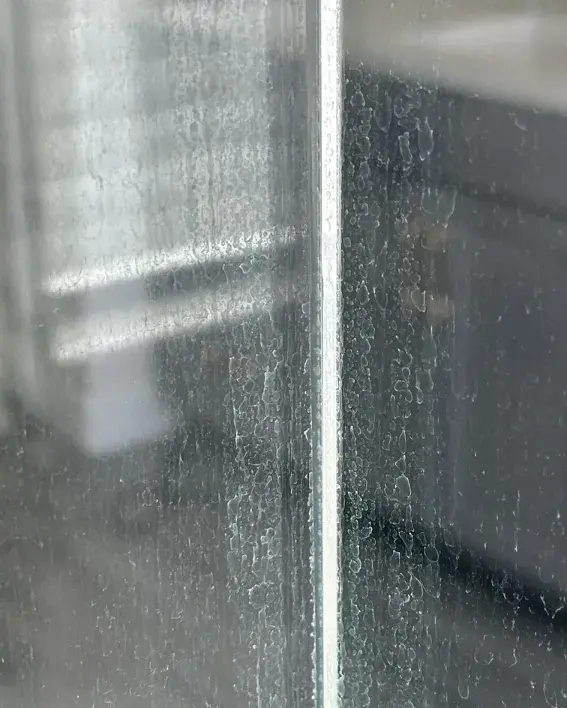
The Four Stages — And What’s Removable at Each One
Not all white spots are the same. The stage of bonding determines what works.
Stage 1 — Surface mineral film
Fresh calcium deposits sitting on the glass, not yet bonded. Fully removable with professional cleaning using deionized water on the first visit. The DI water’s mineral deficiency actively pulls dissolved contaminants from the surface. At Stage 1, nothing special is needed beyond the right water and technique.
Stage 2 — Compound bonded layer
Calcium that has cycled through multiple wet-dry depositions and has begun partially bonding with the glass surface. Still responds to professional cleaning, but the first visit takes more time and may not clear every spot completely. A second pass with the appropriate cleaning chemistry typically finishes the job. The glass feels slightly rough to the touch on affected areas.
Stage 3 — Mineral etching
The calcium has been on the glass long enough to begin a chemical reaction with the silica matrix of the glass surface itself. The glass surface at a microscopic level starts to pit. You can’t see individual pits — you see a milky or frosted appearance in the affected areas that doesn’t fully clear with standard cleaning or DI water alone. This is where hard water spot removal treatment — a separate process with specific chemistry — is needed. Results depend on how deep the etching has penetrated. Most Stage 3 glass responds well to treatment. Deep Stage 3 may show improvement but not full restoration.
Stage 4 — Irreversible etching
The chemical reaction has penetrated beyond the surface coating layer into the glass itself. No cleaning chemistry reverses this — the glass surface has been permanently altered. Professional treatment may improve appearance slightly by addressing surrounding Stage 3 deposits, but the core etching remains. Glass replacement is the only full remedy at this stage.
The honest summary: if you can feel the roughness on the glass surface in the spot area, you’re at Stage 2 or 3. If standard cleaning left the spots unchanged after multiple attempts, you’re likely at Stage 3. If the spots have been on the glass for multiple years without treatment, some Stage 4 etching may be present.
The San Clemente Acceleration Factor
The same calcium deposit that would stay at Stage 1 or 2 for 2–3 years in Sacramento or Seattle progresses to Stage 3 in San Clemente faster — sometimes within 12–18 months on south and west-facing glass.
Two reasons. First, the 625 ppm hard water means more calcium per irrigation cycle than softer-water cities. More calcium depositing daily means faster layer buildup and faster progression through the stages. Second, San Clemente’s 300 days of sunshine means the sun is actively baking the calcium deposits into the glass every morning after the irrigation cycle runs. UV exposure accelerates the chemical bonding between calcium carbonate and silica. What’s a slow background process in overcast climates runs faster under consistent high-UV exposure.
Water hardness above 120 mg/L is classified as hard — San Clemente at 625 ppm is more than five times that threshold. The mineral load depositing on your glass each irrigation morning is proportionally higher than what a soft-water city homeowner experiences.
For Talega and Forster Ranch properties specifically — where irrigation systems often encircle the home on multiple sides and where ground-floor windows on all four elevations may be in irrigation spray range — Stage 3 calcium development within 18–24 months of the last professional treatment is not unusual.

What Doesn’t Work — DIY Limits
White Vinegar
Mild acidity that addresses fresh Stage 1 calcium deposits. Won’t penetrate Stage 2 bonded calcium. Won’t address Stage 3 etching. Leaves its own residue on the glass if not completely rinsed, which can attract further mineral deposits from subsequent irrigation. Useful as a supplemental rinse between professional visits for fresh deposits only.
CLR & Household Calcium Removers
Stronger acidity than vinegar. Effective on Stage 1 and some Stage 2 deposits when applied correctly. Not formulated for glass surfaces specifically — can damage rubber window seals and anodized aluminum frame finishes on repeated application. Not recommended on tinted glass or Low-E coated glass without manufacturer confirmation.
Pressure Washing
Removes loose Stage 1 surface deposits effectively. Does nothing for bonded calcium at Stage 2 or 3. The pressure can force water into window frame seals and degrade weatherstripping. Not a calcium removal solution — it’s a rinsing tool.
Abrasive Scrub Pads
Steel wool, abrasive sponges, or powdered cleansers physically abrade the calcium deposit. The problem: they also abrade the glass surface. Microscopic scratches from abrasive cleaning create more surface area for future calcium to bond to, accelerating Stage 3 development. On San Clemente properties where calcium is an ongoing environmental source, abrasive DIY cleaning makes the long-term problem worse even if it produces short-term visual improvement.
The DIY approach that makes the most sense: a white vinegar rinse on fresh Stage 1 deposits, applied carefully away from rubber seals and aluminum frames, followed by a clean water rinse. For anything beyond that, professional assessment is the right call before attempting DIY chemistry on glass that may already be at Stage 3.
Our Professional Hard Water Spot Removal Process
Professional hard water spot removal uses chemistry that DIY products don’t. The specific compounds vary by product and professional preference, but the effective treatments use slightly acidic or chelating chemistry that’s formulated specifically for glass surfaces — aggressive enough to break the calcium carbonate bond without damaging the silica surface or surrounding materials. The process on a typical Talega or Forster Ranch property with Stage 2–3 lower-floor calcium:
Assessment first
We look at the glass before quoting. We assess which areas are Stage 1–2 (responsive to standard DI water cleaning) versus Stage 3 (needs treatment chemistry) and tell you the honest expected result for each before any work begins. Stage 4 etching is identified and the homeowner is told what’s reversible and what isn’t. No surprises on the invoice.
Standard DI water clean
The exterior cleaning portion of the visit handles Stage 1 deposits throughout. Only the Stage 2–3 spots get the spot removal treatment.
Treatment application
The chemistry is applied to the affected area, allowed to work for the appropriate dwell time depending on deposit age and density, then worked with a non-abrasive technique before rinsing. A second application may be needed on heavy Stage 3 deposits.
DI water rinse
The final rinse removes treatment chemistry residue and the cleaned calcium. The sub-5 TDS DI water leaves nothing on the glass when it dries.
Follow-up maintenance
Hard water spot removal addresses what’s on the glass now. The source — hard water irrigation — hasn’t changed. Ongoing DI water cleaning on the right interval prevents the Stage 2–3 cycle from restarting.
Prevention — The Only Real Long-Term Solution
The most effective hard water spot management strategy isn’t treatment — it’s prevention through deionized water cleaning on the right interval. When glass is cleaned regularly with DI water at sub-5 TDS, the calcium never gets past Stage 1. Each visit removes the surface deposits before they can begin the bonding process. The glass stays at Stage 1 indefinitely on a maintained schedule.
When glass is cleaned with tap water — or not cleaned at all — the calcium progresses through the stages and eventually requires treatment rather than standard cleaning. The cost and time of a hard water spot removal treatment visit exceed the cost of several standard DI water cleaning visits.
Two supporting steps that help between professional visits: adjusting irrigation timer settings so heads that spray directly onto glass run shorter cycles, and rinsing affected glass with a garden hose immediately after irrigation to dilute the calcium before it dries. Neither eliminates the problem — San Clemente’s water is hard, and the irrigation source hasn’t changed — but both slow the Stage 1 accumulation rate between professional visits.
Call (949) 408-1235 — we’ll assess your glass, tell you what stage the calcium is at, and explain what’s achievable before we start.