
Skylight Cleaning in San Clemente, CA — Natural Light Restored, No One Walks on Your Roof
Serving homes in Marblehead · Sea Pointe Estates · Talega · the Pier Bowl · Rancho San Clemente · and renovation properties throughout 92672 & 92673
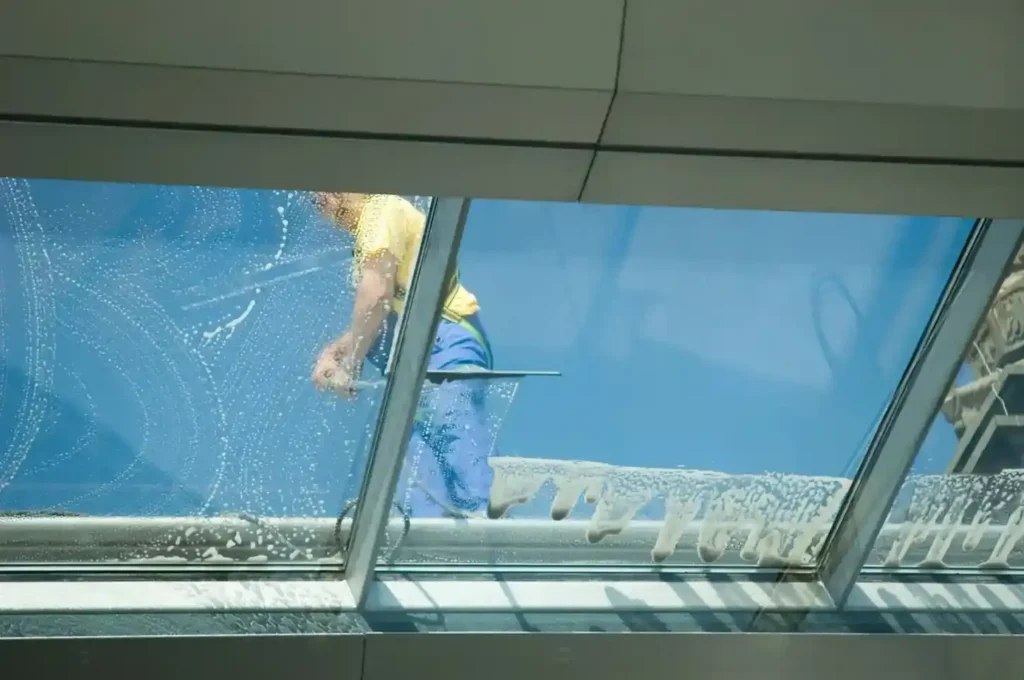
If the Room Feels Darker Than It Used To — Your Skylight Is the Reason
It’s one of the most common things San Clemente homeowners say when they describe a skylight that needs cleaning: “The room just seems darker than it used to.” They assume it’s the light outside, or the season, or something about the room. They don’t connect it to the glass panel in the ceiling. A new clean skylight transmits roughly 87–90% of available natural light into the space below it. That’s what it was doing on the day it was installed.
After one year without cleaning in San Clemente’s coastal environment, that same skylight is typically transmitting 70–75% of available light. After two to three years, 50–60%. After five or more years without professional cleaning, some San Clemente skylights are transmitting 40% or less of the natural light they were designed to deliver.
The room feels darker because it is measurably, significantly darker. And the cause is sitting on the glass above you.
Describe your skylight situation. We’ll tell you what it needs and what it’ll cost.
Why Skylights Get Dirtier Faster Than Any Other Glass Surface in San Clemente
Every window on your home faces the coast at an angle. Rain, when it comes, runs down the glass face and carries some surface debris with it — a partial self-clean that slows deposit accumulation between professional visits. Vertical glass has gravity working partially in its favour. A skylight is horizontal. Everything that lands on it stays there.
The marine layer deposits and sits
San Clemente’s June Gloom marine layer rolls in from the Pacific every morning from late May through early July. On a vertical window, the moisture film collects salt particles and runs down the glass — some of it drips off the sill, some evaporates in place. On a horizontal skylight, that same moisture film spreads across the full glass surface, sits there as the morning fog thickens, and when the sun burns through mid-morning, it evaporates in place — leaving every mineral and salt particle it was carrying deposited directly on the skylight glass with nowhere to go. This cycle happens every day during June Gloom season. Six weeks of daily deposition on horizontal glass, with zero runoff, is why skylight accumulation rates run three to five times faster than vertical windows facing the same coastal exposure.
Rain evaporates instead of running off
San Clemente receives approximately 13 inches of rain annually — concentrated in the December through March winter period. That rain carries OC airborne mineral content from Pacific salt aerosol and local atmospheric particulate. On a vertical window, rain carries surface deposits downward and off the glass. On a horizontal skylight, rain falls on the surface, sits in a shallow puddle, and evaporates — concentrating every mineral it was carrying into a white residue on the glass surface. Every rainfall that doesn’t drain off a flat or low-slope skylight leaves a mineral trace behind. Thirteen inches of rain worth of mineral concentration per year, with no runoff to dilute it.
Bird activity on rooftops
The California gull population in San Clemente is substantial — they roost on rooftops throughout the city, particularly near the waterfront in the pier area and along the coastal bluffs in Southwest San Clemente and Sea Pointe Estates. A horizontal skylight is directly in the drop zone for any bird sitting on or near the roofline. Bird droppings start etching glass on extended contact. On a skylight that’s cleaned annually, the deposits stay surface-level and removable. On a skylight cleaned every few years, bird droppings etching on the glass face is a real risk.
Organic debris from surrounding vegetation
In Marblehead’s canyon-adjacent properties and in Rancho San Clemente where the surrounding hills carry eucalyptus and coastal sage, leaves, bark particles, and organic debris fall on rooftops and collect on skylight glass. Wet organic debris left on glass breaks down into tannins and organic acids over time — the same mechanism that causes tannin staining on glass below gutter outflows. On a north-facing skylight with less direct sun to dry and blow debris clear, organic accumulation can develop into algae or lichen growth on the glass surface given enough time and moisture.
Algae and organic growth on low-light skylights
North-facing skylights and skylights in tree-shaded areas receive less UV than south-facing glass. Without UV to inhibit growth, algae and moss can establish on the glass surface — particularly in the corners and edges where debris accumulates, and moisture persists. Algae is visually obvious — a green or grey-green film — but also physically bonds to the glass surface more aggressively than mineral deposits. It requires specific treatment to remove cleanly without damaging the glass.
Pollen accumulates from above
San Clemente’s spring pollen season — March through May — drops airborne pollen from eucalyptus, coastal sage, Acacia, and ornamental plantings throughout the residential neighbourhoods. Vertical windows shed most pollen in wind and rain. Horizontal skylights collect pollen in a layer that, in spring, can significantly reduce light transmission on its own before the season is over.
Call us and describe your skylight, and we’ll tell you what’s on it and what it’ll take to bring the light back.
How We Clean Skylights in San Clemente — Without Walking on Your Roof
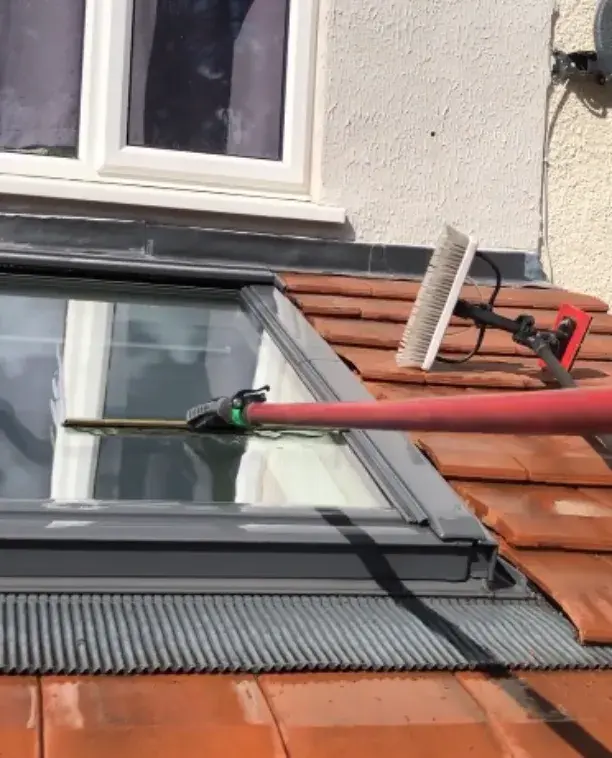
The question every San Clemente homeowner asks before booking skylight cleaning: can you do it without walking on my roof? The answer, in almost every case, is yes.
Why does this matter specifically in San Clemente?
Clay terracotta tile is on the majority of Spanish Colonial homes in San Clemente — from the historic pier area properties built in the Ole Hanson era to the custom estates in Marblehead and Sea Pointe Estates. Clay tile is brittle. It is not designed to bear concentrated foot traffic. One misstep by an operator walking to reach a skylight can crack or shatter a tile — and clay tile replacement in San Clemente, where matching original terracotta from the 1920s through 1970s is increasingly difficult, can run $50–$150 or more per tile plus labour.
Concrete tile — common on newer Talega and Marblehead construction — is more durable but still not intended for regular foot traffic across the full roof surface. Concrete tile can crack under point-load weight, and the grout and sealant between tiles is compromised by repeated pressure.
Our approach
We use a water-fed carbon fibre pole system that extends to reach most residential skylights from the gutterline or from a ladder positioned safely at the eave — without the operator setting foot on the roof tile surface. The pole carries deionised water from our truck system through its hollow core to a brush head at the tip. The brush head reaches the skylight surface, scrubs the glass and any frame perimeter, and the DI water rinses the loosened contamination off the surface and out of the skylight frame.
For skylights near the ridge of a steep pitch roof where the pole reach from the gutterline is insufficient, we discuss access options with the homeowner before the job. In some cases, a flat section of roof adjacent to the skylight provides safe footing. In others, a longer pole extension or a specific ladder position resolves the access without tile contact. We never improvise the access on the day without your knowledge and agreement.
Call now, and tell us your roof type and skylight location, and we’ll tell you exactly how we’d approach it.
What We Find on San Clemente Skylights — and What Each Requires
No two skylight cleaning jobs are identical. What’s accumulated on the glass determines the approach, the chemistry, and the time required. We assess before we start.
The baseline coastal accumulation — marine layer salt, OC rainfall mineral residue, airborne calcium particles. Looks like a milky haze or soft white film on the skylight glass. Responds to DI water scrub-and-rinse on a standard annual or biannual cleaning schedule. This is the most common condition on maintained skylights in Marblehead and Sea Pointe Estates that get cleaned once or twice a year.
On skylights that haven’t been cleaned in two or more years, a layered buildup of mineral deposits, pollen residue, and organic particulate creates a thicker film. The pollen and organic layer on top requires scrubbing and rinsing before the mineral film underneath can be addressed. This takes longer than a standard clean, but the same DI water process handles it — no specialty chemistry needed in most cases if the glass hasn’t progressed to mineral etching.
Concentrated bird dropping accumulation on a skylight that’s been uncleaned for extended periods. Uric acid from droppings etches glass on contact, and the etching deepens with time. Fresh droppings (within weeks) respond well to removal with a wet application and careful scrubbing. Older, etched deposits may require the same calcium dissolver and glass restoration process used on hard water etching — the chemistry addresses the uric acid component and the etching treatment addresses the altered glass surface.
North-facing or shaded skylights with visible green or grey-green growth. Algae bonds to the glass surface and requires a specific biocidal cleaning agent to kill the growth before removal — rinsing algae off without killing it first just spreads it. After biocidal treatment and dwell time, the dead algae is removed with the DI water rinse process. This is a more involved clean than standard mineral film removal, but the result — a fully clear skylight with no remaining organic growth — is worth the additional step.
On new builds and renovations in Talega, Marblehead, and Sea Summit, skylight glass frequently has a specific contamination load from adjacent construction work — protective film adhesive residue, stucco haze from adjacent wall finishing, shingle granules and tile adhesive from surrounding roof work. We treat post-construction skylight contamination with the same process as post-construction window cleaning — assessment first, appropriate chemistry for each contamination type, razor blade work where needed, DI water final clean.
Tubular skylights (Solatube and similar), older polycarbonate panel skylights, and some domed skylight covers are not glass — they’re thermoplastic. These require completely different handling from glass skylights. Acid-based cleaners will cause polycarbonate to craze — develop a network of fine surface cracks that permanently cloud the material. High-pressure water can cause polycarbonate to distort or crack at joints. We clean polycarbonate and acrylic skylight covers with mild pH-neutral cleaners and microfiber only — no acid chemistry, no high pressure, no abrasive tools.
Not sure what’s on your skylight? Call us and describe what you’re seeing, and we’ll identify it before we quote.
Types of Skylights We Clean in San Clemente
Types | Description |
Fixed glass skylights | The most common type in San Clemente homes — a sealed glass unit that doesn’t open, set into the roof with a frame and flashing. These range from small 2×2 units in bathrooms and hallways (common in historic pier area homes where light was added to original dark interiors) to large 4×6 and 6×8 units in great rooms and master suites of custom Marblehead and Sea Pointe Estates builds. Fixed skylights have the flattest profile of all skylight types and accumulate the most per-square-foot because no ventilation lifts debris clear of the glass. |
Vented/operable skylights | Skylights that can be opened for ventilation — common in the ridge homes in Marblehead where cross-ventilation is a design priority. The glass panel on a vented skylight accumulates the same coastal contamination as a fixed unit when closed. When open, the interior glass face also accumulates condensation and interior air quality deposits. We clean both the exterior glass face and — where accessible from the interior — the interior face of vented skylights. |
Roof windows (VELUX and similar) | Installed in steeper pitch roof areas — often in Marblehead and Coast District homes where the roof slope allows flush installation. The steeper pitch angle gives roof windows slightly better self-cleaning characteristics than flat skylights (more rain runoff), but they still accumulate significantly more than standard vertical windows. The cleaning approach is the same as flat skylights — water-fed pole from the gutterline where the pitch allows. |
Tubular skylights/sun tunnels (Solatube and similar) | A domed polycarbonate or acrylic diffuser on the roof connected to a reflective tube that brings light into interior spaces without a full skylight opening. The dome on the roof is the external glass equivalent — it accumulates the same coastal contamination but is made of polycarbonate rather than glass. Requires the polycarbonate-specific gentle cleaning approach described above. Common in Talega and Forster Ranch homes where full skylight installation wasn’t in the original build plan. |
Polycarbonate patio cover panels | Some San Clemente homes — particularly in Talega and Forster Ranch — have patio covers with translucent polycarbonate panels that function like horizontal skylights for the patio area below. These accumulate the same marine layer and organic debris as roof-level skylights. Same polycarbonate-specific cleaning protocol — mild pH-neutral cleaner, microfiber only, no acid, no pressure. |
Skylight Cleaning Frequency in San Clemente — What Actually Holds
The right cleaning interval for a San Clemente skylight depends on its orientation, its roof position, and what surrounds it.
Annual cleaning establishes a baseline and prevents early accumulation from progressing to mineral etching during the critical period when the glass surface is freshest and most receptive to bonding contamination.
Every 6–8 months. Less UV means slower mineral baking but more organic growth risk. Algae establishes faster on shaded glass. More frequent cleaning prevents organic growth from becoming a bonding problem.
Every 6 months during spring and autumn when deciduous debris and pollen loads are highest. Organic matter on glass in these locations breaks down faster than in open coastal positions.
Same as vertical window intervals at this proximity — every 8–10 months for most units, more frequently for skylights directly exposed to coastal bird activity.
Once every 12 months minimum. The UV from full sun slows organic growth but accelerates mineral baking. Marine layer deposits from the Pacific accumulate year-round on these orientations. Annual professional cleaning prevents the progression to mineral etching that makes future cleaning significantly harder and more expensive.
Call us, and we’ll tell you how often your specific skylight needs cleaning based on its position, roof type, and exposure zone.
Where Skylights Are Most Common in San Clemente
Marblehead — The Crest, Sea Summit, Signal Point (92672)
Custom builds on Marblehead’s ridgeline and hillside positions use skylights extensively for passive solar lighting and for the visual connection between interior spaces and the open sky that the elevated position allows. The Crest properties in particular — large custom estates with significant glass and open floor plans — often have multiple skylights in great rooms, kitchens, and master suites. These properties have the most skylight glass per home of any neighbourhood in San Clemente.
Sea Pointe Estates (92672)
The custom estates in Sea Pointe Estates frequently include skylights as part of the design intent for large interior spaces. The bluff-top position and the large home footprints mean skylights are a practical solution for bringing light into rooms that don’t face the ocean view wall directly. These skylights face San Clemente’s most aggressive marine layer exposure.
Downtown and Pier Bowl renovation properties (92672)
The historic Ole Hanson-era homes near the pier were built in the 1920s and 1930s with interior layouts that prioritised space over natural light. Renovation projects on these historic homes frequently add skylights to bathrooms, hallways, and kitchens — small to mid-size fixed units that bring daylight into spaces that previously had none. These renovated skylights are often in positions where the original design never planned for easy cleaning access.
Newer Talega sub-communities (92673)
Higher-end spec homes in some Talega sub-communities were built with skylights as standard — particularly in the larger four and five-bedroom homes in the newer sub-communities developed in the 2000s and 2010s. These skylights face Talega’s irrigation-driven mineral deposit environment rather than coastal salt air.
Rancho San Clemente hillside properties (92672)
Canyon-facing hillside homes in Rancho San Clemente use skylights to bring light into rooms that face the canyon rather than the street. These skylights are in positions where eucalyptus and native canyon vegetation overhead means higher organic debris loads than coastal-zone skylights.
Skylight Cleaning Pricing in San Clemente
Skylight cleaning is priced by unit based on size, access difficulty, and contamination level. Standard residential skylights in San Clemente range from small bathroom units to large architectural panels.
Property Details | Pricing Structure |
Standard fixed skylight | Up to approximately 4×4 feet, accessible from gutterline with water-fed pole starting from $75–$120 per unit. |
Larger architectural skylights | 4×6 feet and above. Starting from $120–$200 per unit depending on size. |
Skylight cleaning combined with full exterior window clean visit | Combined pricing — the most efficient approach since the pole system and DI water setup is already on-site for the window clean. Skylight add-on to a full window cleaning visit is quoted at a reduced per-unit rate. |
Polycarbonate and acrylic skylight covers | Tubular skylights, patio cover panels. Starting from $60–$100 per unit — same pricing structure as glass but with the polycarbonate-specific cleaning approach. |
Post-construction skylight clean | Quoted individually based on contamination type and scope — same approach as post-construction window cleaning. |
Access surcharge | For skylights where pole reach from the gutterline is insufficient and a specific access solution is needed, we discuss and quote the access approach before the job. Not all skylights require an access surcharge — most standard San Clemente residential skylights are reachable from the eave position. |
Call us with your roof type (clay tile, concrete tile, flat), approximate skylight size, and location on the roof. Most skylight quotes take under 2 minutes by phone.
What San Clemente Homeowners Say About Our Skylight Cleaning
Ready to bring the light back? Call (949) 408-1235 — most skylight quotes done in 2 minutes.
Book Skylight Cleaning in San Clemente
Step 1. Call us at (949) 408-1235
Tell us your roof type (clay tile, concrete tile, flat), the approximate size of your skylight, and where it sits on the roof. We can quote most San Clemente residential skylights by phone in under 2 minutes.
STEP 2. Access Approach Confirmation
We confirm the access approach and arrive with the right pole length for your roof configuration.
STEP 3. Cleaning USING DI Water
DI water scrub and rinse; no foot traffic on your roof tiles; specific chemistry for any algae or heavy organic accumulation.
Step 4. Pay after 100% satisfaction
Interior light quality restored. Walk-through confirmation before we leave.

Frequently Asked Questions — Skylight Cleaning San Clemente
Still have a question not answered here?
Call us (949) 408-1235 — real person, no hold queue, during business hours.