
Deionized water window cleaning — Why It’s the Only Method That Works on Coastal Glass
Discover how our multi-stage pure water system strips away San Clemente’s 560–680 ppm mineral hardness to leave your windows completely spotless. By using advanced water-fed poles, we rinse away stubborn Pacific salt spray and irrigation film without leaving behind streaks or residue. Experience the professional window cleaning method engineered to keep San Clemente coastal glass crystal clear for weeks.
What Deionized Water Actually Is — And Why Window Cleaners Use It
Most homeowners hear “deionized water” and picture something complicated. It isn’t. Here’s the plain version. Regular tap water — the water coming out of your hose or faucet — carries dissolved minerals. Calcium, magnesium, sodium, silica. These minerals are invisible while the water is liquid. But when the water dries on your glass, the liquid evaporates, and the minerals stay behind. What’s left on the surface is a white mineral film — the spots, streaks, and haze that show up within days of a standard window clean.
In Orange County, City of San Clemente tap water averages 625 ppm TDS (Total Dissolved Solids), ranging 560–682 ppm across distribution zones — well into the “very hard” category. Every drop of tap water that touches your glass and dries leaves a proportional amount of mineral residue behind.
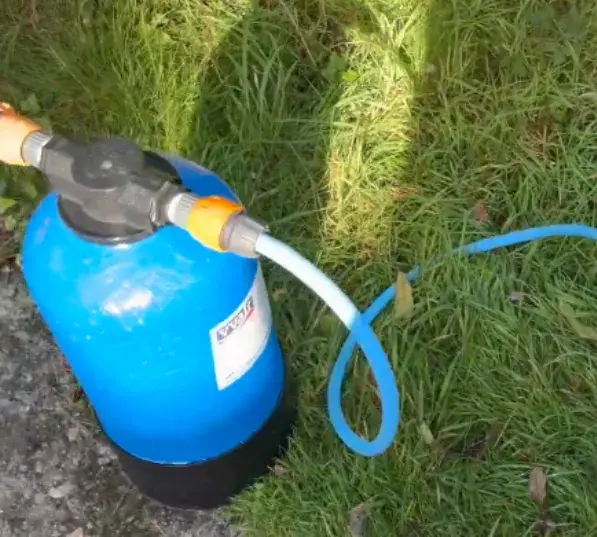
Deionized water has had those minerals removed. The deionization process strips dissolved ionic compounds from the water — calcium, magnesium, sodium, chloride — until the water reads near zero TDS. At sub-5 TDS, the water is essentially pure H₂O. When it dries on glass, there’s nothing left behind. The surface dries completely clean — no mineral film, no streaks, no spots. That’s the entire mechanism. Pure water dries clean. Mineral-loaded water dries dirty.
Call (949) 408-1235 — want to know what TDS reading we run before we touch your glass? Ask us on the call.
How the Deionization Process Works
There are two common methods for producing deionized water for window washing — reverse osmosis and ion exchange resin. We run an in-truck system that uses a combination of both.
Reverse osmosis (RO) — the first stage
Reverse osmosis is the same technology used in high-end home water filtration systems. Water is forced through a semi-permeable membrane under pressure. The membrane blocks dissolved solids and allows purified water through. A standard RO system removes 90–99% of dissolved minerals. The output is significantly cleaner than tap water but typically still reads 10–50 TDS — not clean enough to dry spot-free on glass.
Deionization (DI) resin — the second stage
The RO-filtered water passes through a tank filled with ion exchange resin. The resin contains charged polymer beads — some positively charged (cation resin), some negatively charged (anion resin). As the water passes through, positively charged mineral ions (calcium, magnesium, sodium) bind to the cation resin, and negatively charged ions (chloride, bicarbonate) bind to the anion resin. What comes out is water with virtually zero ionic content.
The TDS meter check
Before we touch a single pane, we check the TDS reading on the water coming out of the system. Our target is below 5 TDS — at that level, the water is pure enough to dry completely spot-free on glass. If the reading is above 10, we don’t start. The DI resin is exhausted and needs replacement. This is not a theoretical quality check — a window cleaner in our YouTube research literally had to redo an entire job because he forgot to check the TDS meter before starting. We don’t skip this step.
We run TDS below 5 on every visit. That’s the standard.
Why Tap Water Window Cleaning Fails on Coastal Glass
To understand why deionized water matters in San Clemente specifically, you need to understand what’s already on your glass before the window cleaner arrives. San Clemente’s coastal position means every exterior glass surface in the city is dealing with at least two contamination sources simultaneously:
Pacific salt air deposits constantly. Sodium chloride particles from wave action and ocean spray travel inland and settle on all exterior glass surfaces. On bluff-front properties in Cyprus Shore, Sea Pointe Estates, and the Pier Bowl, this deposition happens within hours of a clean. Further inland in Talega or Rancho San Clemente, the accumulation is slower but consistent.
Irrigation systems add hard water calcium. Santa Margarita Water District water in Talega and City of San Clemente water in Forster Ranch, Marblehead, and Rancho San Clemente both run at high TDS levels. Irrigation systems cycling every morning deposit dissolved calcium and magnesium on lower-floor glass with every pre-dawn cycle. When a window cleaner uses tap water on glass that already has these two contamination layers, here’s what actually happens:
- The tap water (carrying its own mineral load) contacts the glass surface
- The scrubbing action loosens the salt film and calcium deposits.
- The rinse water runs over the glass, carrying the loosened contamination plus its own mineral content.
- The water dries — and everything that was dissolved in it stays on the glass.
- The clean looks good for a few days while the glass is still wet-looking.
- As it fully dries, the mineral film from the cleaning water itself becomes visible.
- The next morning’s irrigation cycle adds another calcium layer on top.
- Within a week, the glass looks almost as contaminated as before the clean.
This is the cycle San Clemente homeowners describe when they say “the windows look good for a few days and then they’re back to hazy.” It’s not the cleaner’s effort that was wrong. It’s the water.
Deionized water breaks the cycle by eliminating the mineral contribution from the cleaning water itself. The rinse leaves nothing behind. The environmental contamination — salt air, irrigation calcium — will still accumulate after the clean. But the compound effect of the cleaning water adding to it is gone. The clean holds significantly longer.
Experiencing the one-week haze cycle? That’s a tap water problem. Call us
The Water-Fed Pole System — How Deionized Water Gets to Your Glass
Deionized water doesn’t work the same way as traditional soap-and-squeegee cleaning. The delivery system is completely different.
The water-fed pole
A hollow carbon fiber pole — ours extends to 50 feet — delivers deionized water through its core to a brush head at the tip. The operator works from the ground. The brush head reaches the glass surface and scrubs the contamination free. The continuous flow of deionized water rinses the loosened debris down and off the glass as it goes.
No squeegee needed
Traditional window cleaning uses a squeegee to physically remove the water from the glass — because the water has minerals in it that will spot if left to dry. With deionized water, there’s nothing in the water to spot. You let it dry on its own. No streaks, no water marks. Just glass.
What the brush does
The brush head on the water-fed pole has soft flagged bristles designed for glass. The scrubbing action breaks the bond between the contamination (salt film, mineral deposits, dust) and the glass surface. The deionized water rinse carries it away. On heavily contaminated glass — first cleans on Pier Bowl properties after a June Gloom season, or first cleans on Talega homes with multiple seasons of irrigation calcium — the brush agitation is what separates a thorough clean from a surface rinse.
Upper-floor glass without ladders
The pole system is what allows us to reach second-story and roofline-adjacent glass from the ground. On Forster Ranch and Talega homes with aluminum patio covers, no ladder ever contacts the cover surface. On Marblehead homes with clay tile roofs, no foot ever touches the tile. The pole reaches it all from the gutterline.
Inside the truck
The deionization system lives in our vehicle. We fill the tank with regular water at the start of the day, run it through the RO membrane and DI resin stages, and draw from the purified reservoir throughout the job. The TDS meter monitors the output continuously — we know the water quality at every point in the visit.
Carbon fiber pole, DI water under 5 TDS, upper-floor glass reached from the ground.
TDS Explained — The Number That Tells You Everything About Your Water
TDS stands for Total Dissolved Solids. It’s measured in parts per million (ppm) — the number of milligrams of dissolved material in every liter of water.
The scale:
TDS Level | Classification | What It Means for Glass |
0–50 ppm | Pure / Deionized | Dries spot-free — no mineral residue |
50–150 ppm | Low mineral content | Light spotting on drying, minimal |
150–300 ppm | Moderate hardness | Noticeable mineral film on drying |
300–500 ppm | Hard | Visible spotting and streaking on glass |
500–700 ppm | Very hard | Heavy mineral residue — San Clemente range |
700+ ppm | Extremely hard | Rapid calcium bonding on glass surfaces |
San Clemente tap water: around 600 TDS. The City of San Clemente’s 2025 Water Quality Report records an average TDS of 625 ppm with a range of 560–682 ppm across distribution zones. Santa Margarita Water District, serving Talega, runs similarly. This puts San Clemente squarely in “very hard” territory — near the top of the scale for residential tap water in Southern California.
At 600 TDS, a window cleaner using tap water is depositing roughly 600 mg of dissolved minerals per liter of water used. On a standard two-story home clean using 30–40 liters of water, that’s 18,000–24,000 mg of mineral content left on your glass and frames when the water evaporates.
Our system runs below 5 TDS. At sub-5 TDS, the residual mineral content per liter of water is less than 5 mg. The difference between 600 TDS tap water and 5 TDS deionized water is not subtle — it’s the difference between a clean that hazes within a week and a clean that holds for weeks.
Want to know what TDS level your tap water runs? We can test it on arrival.
Why Deionized Water Is Especially Important in San Clemente
Reason 1
The tap water is exceptionally hard. Water with more than 180 mg/L of dissolved calcium carbonate is classified as very hard by the United States Geological Survey. San Clemente’s tap water at 560–682 ppm TDS sits well above that threshold. The gap between tap water mineral content and DI water mineral content is wider here than in most California cities — which means the benefit of switching from tap to DI is larger here too.
Reason 2
The salt air adds a second contamination layer. San Clemente’s Pacific position means exterior glass is constantly receiving salt deposition on top of whatever mineral residue the cleaning water left. A clean done with tap water leaves mineral residue on the glass. The salt air deposits more on top. The compounding of these two sources is what causes the rapid haze-back that San Clemente homeowners experience. DI water eliminates one of the two sources — which materially changes how long the clean holds.
Reason 3
The coastal sun bakes everything in. San Clemente enjoys roughly 300 days of sunshine per year. The same sunshine that makes it one of the most desirable places to live in California also bakes mineral deposits onto glass faster than in cloudier coastal markets. Tap water mineral residue left on glass in direct San Clemente sun doesn’t just sit there — it bonds to the glass surface. Over multiple cleaning cycles with tap water, that bonded mineral layer builds to the point where it can’t be cleaned off with standard methods. That’s hard water etching — the stage where our hard water spot removal treatment is needed rather than standard cleaning.
Deionized water on every visit, no exceptions. That’s how we work in San Clemente.
Our Deionized Water Window Cleaning Process
Here’s exactly what happens during a deionized water window cleaning visit — because understanding the process is what separates trusting it from wondering why there’s no soap involved.
TDS Check First
Before we touch a single window, we run the TDS meter on the water coming out of the system. A sub-5 reading means we’re good to go. If the DI resin is depleted and the reading is too high, we don’t start. This actually happened to a window cleaner in one of the YouTube training videos we studied — he had to redo an entire job because he skipped the TDS check. We don’t skip it.
Wet The Glass
We start at the highest accessible window and work down. The brush head delivers deionized water to the glass and scrubs from top to bottom — not side to side. The water flow carries loosened contamination downward, away from cleaned glass above.
Brush Work
On a first clean with significant salt film or irrigation calcium, the brush agitation is what breaks the contamination bond. On maintained glass, a lighter scrub is enough. The brush angle, the water volume, and the dwell time on contaminated sections — these are the judgment calls that make the difference between a thorough clean and a cosmetic rinse.
Frames and Sills
We wet and brush the frame perimeter and clean the sill on every window, not just the glass pane. This matters because contamination in the frame channels runs back onto clean glass within hours — especially on properties where the morning marine layer creates moisture movement down the frame. Cleaning only the pane and leaving the frame is how a clean looks right for a day and hazes from the frame within 48 hours.
Let it Dry
No squeegee, no towels, no wipe-down. The deionized water dries on its own and leaves nothing. In San Clemente’s morning marine layer air, exterior glass after a DI clean dries to clarity within 20–30 minutes. The result should look as though the glass isn’t there.
This is how every visit works. No shortcuts on the TDS check, no skipping frames and sills.
How to Book Deionized Water Window Cleaning?
Every visit we run in San Clemente uses deionized water. It’s not an upgrade option or a premium tier — it’s the standard because it’s the only method that holds on coastal glass with hard tap water.
Step 1. Call us at (949) 408-1235
Tell us your address and what you’re seeing on your glass — salt haze, hard water spots, or a general clean that isn’t holding.
STEP 2. Confirm Schedule
We’ll tell you what’s on it and what the first visit will involve, and we quote you on the call, confirm availability, and schedule the visit.
STEP 3. Cleaning & Payment
We clean. Raking light walk-through before we leave. You pay after — not before.

Common Questions About Deionized Water Window Cleaning
Still have a question not answered here?
Call us (949) 408-1235 — real person, no hold queue, during business hours.