
After the Santa Ana Winds: Why San Clemente Homeowners Should Clean Their Windows Now

After a significant Santa Ana wind event in San Clemente, you have a 3–5 day window to clean your exterior glass before Pacific moisture bonds the desert dust and ash to the surface. After that window closes, what was a straightforward debris removal becomes a compound cleaning problem. The dust isn’t permanent on day one. It may be by day ten. If winds hit your neighborhood in the last few days, this is the post for you.
Call (949) 408-1235 — we run priority callbacks after major Santa Ana events. If slots are available, we can get to you.
What Santa Ana Winds Actually Deposit on Your Glass
Most homeowners assume a Santa Ana event just leaves dust. It’s more specific than that — and the specificity matters for how you respond.
Fine Silica
Fine silica particulate from desert air. Santa Ana winds originate in the inland desert areas and travel through the canyon corridors toward the coast. By the time they reach San Clemente, they carry fine silica particles — desert soil, dried chaparral, and mineral dust from the Ortega Highway corridor and the Santa Ana Mountains. Silica is abrasive. When it’s dry and loose on your glass, it can be swept off without scratching. Once moisture contacts it, silica fines bond to the glass surface and require agitation — not just rinsing — to remove cleanly.
Ash
Ash from inland wildfire activity. Santa Ana conditions — low humidity, high wind, dry vegetation — are prime wildfire conditions throughout interior Southern California. When fires are burning further inland during a Santa Ana event, the wind carries light ash particles alongside the silica dust. Ash has a different chemistry from mineral dust — it’s alkaline, fine, and when it contacts the moisture in a marine layer, it creates a slightly caustic film on the glass surface that’s more aggressive than the dry ash alone.
Canyon Dust
Canyon dust from the Ortega Highway corridor. San Clemente’s eastern exposure — particularly for Marblehead ridge properties, Talega’s foothill perimeter, and Rancho San Clemente’s canyon-facing elevations — draws dust specifically from the Ortega Highway corridor between San Clemente and Lake Elsinore. This is a mix of road particulate, eroded clay, and dried chaparral that concentrates at ridge elevations where the wind funnels through. Marblehead’s Crest section and Signal Point positions catch this as much as they catch Pacific salt from the west.
All three arrive simultaneously during a significant event. The visible result is a thin, uniform gritty film on every exterior surface — windows, frames, sills, tracks, and screens — that appears overnight.
What month has the strongest Santa Ana winds?
October and November are the peak months for Santa Ana wind intensity and frequency in Southern California. The pattern is driven by the temperature differential between the cooling desert interior and the warmer coastal strip — the contrast is greatest in fall, making October and November the months with the most frequent and strongest events. December can also produce significant events, but intensity typically decreases through mid-winter. For San Clemente homeowners, October is the month to have a post-event cleaning plan ready — events arrive with less warning than later in the season, and the cumulative fire activity from a dry summer means ash content in the wind is often higher.
The 3–5 Day Window — Why Timing Is Everything
This is the central fact of post-Santa Ana window care: the debris sitting on your glass right now is significantly easier to remove than it will be in five to ten days. Dry silica and ash particulate on glass surfaces are surface contaminants — they haven’t bonded to the silica in the glass itself. A deionized water scrub and rinse removes them cleanly on the first pass within the window.
Then the marine layer comes back. Santa Ana conditions are characterized by low humidity and offshore winds. The moment the offshore wind pattern breaks, the normal onshore Pacific flow returns — along with the marine layer moisture that characterizes San Clemente’s weather the other 340+ days of the year. That moisture contacts the silica and ash particles sitting on the glass and begins the wet-dry bonding cycle that causes harder-to-remove compound deposits.
After a Pacific moisture return, the ash alkalinity and the silica particulate have begun adhering to the glass surface. A standard rinse won’t clear it anymore — agitation with a brush is needed. If the marine layer then cycles multiple times before cleaning happens, the deposits compound with the salt and minerals the marine layer itself deposits, and you’re dealing with a mixed contamination layer that requires significantly more work than the original post-wind cleanup.
The 3–5 day window is based on how quickly Pacific moisture returns to coastal positions after typical Santa Ana events in San Clemente. It’s not a hard deadline — it varies by event intensity and subsequent weather — but calling on day two rather than day nine consistently produces faster, simpler, less expensive cleanings.
A homeowner in Marblehead’s Crest section called us on day four after a significant November event. The winds had run three days from the northeast, pushing ash from inland wildfires across the ridge in addition to the standard silica load. Day four was still within the window — the ash and dust hadn’t yet fully bonded. We got everything off cleanly. They specifically asked about future events, and we set up a flexible schedule with priority callback slots — so when the next one hits, they’re already in the queue rather than calling and hoping for availability.
Where are Santa Ana winds the worst in and around San Clemente?
Ridge and elevation-exposed properties take the worst of it. Marblehead’s Crest and Signal Point sections sit above the coastal plain and funnel wind from the northeast canyon corridor — these positions see the heaviest silica and ash loading of any San Clemente neighborhood during major events. Talega’s foothill perimeter, particularly the outer communities facing the Santa Ana Mountains, receives direct canyon flow from the Ortega Highway corridor. Southwest San Clemente bluff properties experience the dual problem of canyon dust from the northeast landing on glass that’s already accumulating Pacific salt from the west. Inland Orange County cities like Corona, Riverside, and Anaheim Hills regularly record the strongest raw wind speeds in Santa Ana events — coastal San Clemente sees moderate wind speeds but concentrated particulate loading from the canyon funneling effect.
Call (949) 408-1235 — if the winds hit in the last few days, the window is still open. Call now.
Which San Clemente Properties Take the Hardest Hit
Not all positions are equal during a Santa Ana event.
Marblehead Ridge Properties
The Crest, Signal Point, Sea Summit — these sit at elevation above San Clemente’s coastal plain and face both directions: ocean from the west and canyon corridor from the east. During a Santa Ana event with northeast winds, the east-facing glass on these properties receives the heaviest silica and ash loading. Upper-floor east-facing windows typically show heavier coating than lower floors — the opposite of the marine layer pattern, where ground-level glass sees more salt. After a significant event, Marblehead Ridge homes often need cleaning on the east and north elevations that matches what a bluff-front home experiences from Pacific salt.
Talega Foothill Perimeter
Talega sits at the northeast edge of San Clemente, brushing the Santa Ana Mountain foothills. During Santa Ana events, the community receives some of the most direct canyon dust exposure in San Clemente — the Ortega Highway corridor runs directly northeast of the Talega boundary. Homes on Talega’s outer perimeter facing the foothills, particularly in the higher-elevation sub-communities, see consistent coating during events. The HOA exterior standards in Talega mean post-Santa Ana accumulation is also a compliance issue, not just an aesthetics one.
Southwest San Clemente Bluffs
Properties at Cyprus Shore, Cotton’s Point, and the bluff edge above Trestles already deal with the most aggressive Pacific salt exposure in San Clemente. During a Santa Ana event, the canyon dust from the east is added to the existing coastal contamination profile. Because these properties are already being cleaned on 6–8 week cycles, a significant Santa Ana event between visits can push the glass to a point where the scheduled visit needs to be moved up rather than waited for.
All Glass-Heavy Properties
Any San Clemente home with large picture windows, west-facing ocean views, or significant glass-to-wall ratio on canyon-facing elevations shows Santa Ana coating prominently. The dust settles uniformly on all exterior surfaces — but on large glass panels, the gritty film is particularly visible in morning light.
What the Cleaning Process Looks Like Post-Santa Ana
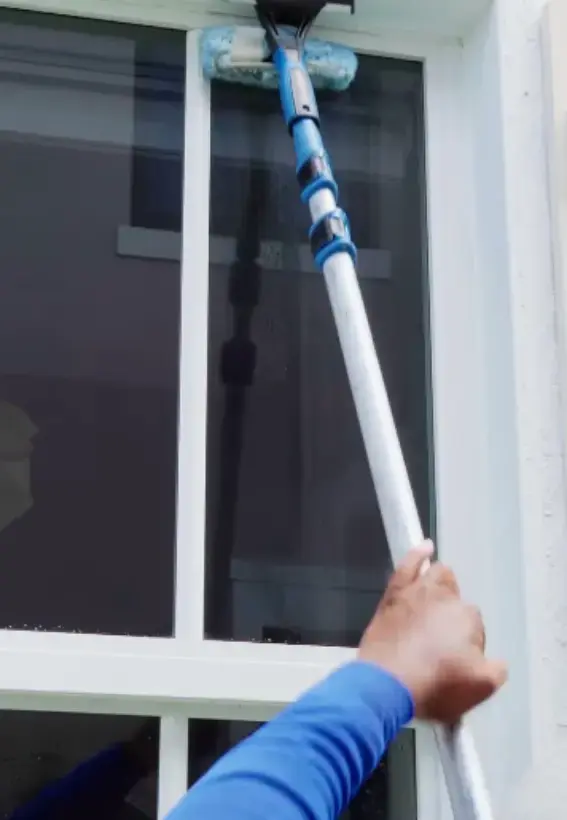
Post-Santa Ana window cleaning differs from a standard visit in one important way: the debris needs agitation, not just rinsing. Pacific salt film and hard water calcium respond to the DI water rinse — the pure water’s mineral deficiency pulls them off the glass surface. Silica and ash particulate doesn’t respond to rinsing alone — the fine particles need the brush head of the water-fed pole making physical contact with the glass surface to dislodge them before the rinse carries them off.
This means the brush pass on every pane is more important than usual after a Santa Ana event. A rinse-only approach on post-Santa Ana glass leaves silica in place on the surface. A thorough brush-and-rinse approach removes it completely within the 3–5 day window.
Tracks Cleaning
The horizontal tracks of sliding glass doors and sliding windows collect visible lines of ash and silica during Santa Ana events. The tracks act as catch channels — the wind-driven particles settle into the track groove and concentrate there. Leaving the tracks uncleared means the same ash that landed on your exterior glass gets transferred back inside every time the door opens. Every track on every cleaned window is wiped out on post-Santa Ana visits.
Interior Cleaning (if windows were open)
If windows or sliding doors were open during the event — common during the warm, dry Santa Ana conditions before homeowners realize the ash is coming — ash and silica have entered the interior. Interior glass on canyon-facing elevations in Marblehead, Talega perimeter properties, and Rancho San Clemente often needs attention after significant events when doors were open to the warmth. Shoe covers at the threshold, spray bottle only inside, lint-free microfiber — same interior protocol as standard.
Screens Assessment
Screen mesh traps Santa Ana particulate in the mesh fibers differently than it traps salt aerosol. The fine silica and ash concentrate in the mesh and can create a gritty film that transfers to the glass when moisture contacts the screen. We assess screens after every major event — clean them separately from the glass, not at the same time.
Are Santa Ana winds cold or hot?
Santa Ana winds are hot and dry — the opposite of what most people expect from a California wind. Santa Ana winds begin as cold, high-pressure air over the Great Basin desert, but as that air descends through mountain passes toward the coast, it compresses and heats rapidly — a process called adiabatic heating. By the time the wind reaches San Clemente, temperatures regularly hit the 80s and 90s°F with humidity below 10%. The warm, dry, fast-moving air is what makes Santa Ana events feel so distinct from the cool marine layer conditions San Clemente sees most of the year — and what makes the dust they carry bond to glass surfaces so aggressively once the offshore flow stops and moisture returns.
Two to Three Events Per Season — What to Plan For
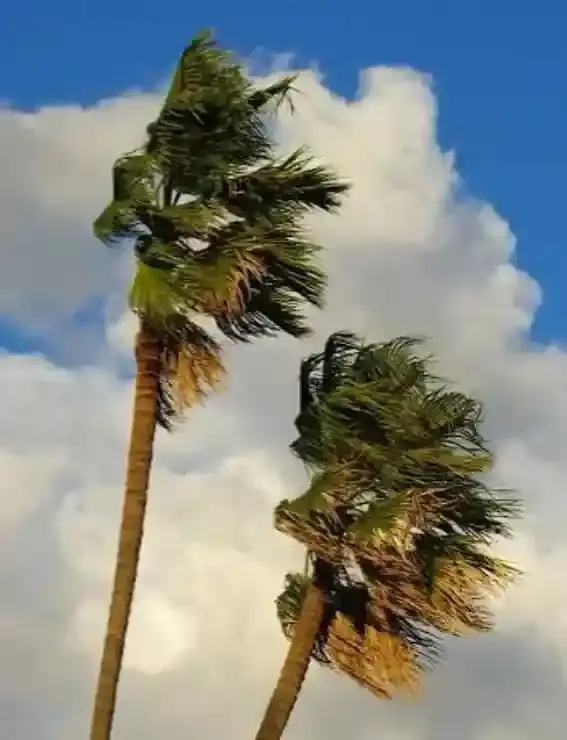
Santa Ana winds are hot, dry, and fast — temperatures in San Clemente regularly climb into the 80s and 90s°F during events while humidity drops below 10%, the opposite of the cool marine layer conditions the city normally sees. Santa Ana seasons in San Clemente typically produce two to three significant wind events between October and December, with an occasional late-season event in late March or early April. October and November carry the strongest and most frequent events — the peak of Santa Ana season when inland fire risk is highest, and the winds most reliably reach coastal communities. Not every event reaches the same intensity — some produce light dust that a garden hose rinse handles between regular professional visits; others coat every exterior surface overnight and require a dedicated post-event cleaning.
According to CAL FIRE’s active incident tracking, Santa Ana wind conditions are the primary driver of wildfire spread in Southern California. When fire activity is occurring inland during a Santa Ana event, the ash component of what deposits on San Clemente glass is significantly higher — and the alkaline ash chemistry makes the post-event cleaning timeline more critical than a dust-only event.
For homeowners on a recurring cleaning schedule, the approach is: standard scheduled visits on the normal interval for your coastal position, plus priority callback scheduling after significant events. You don’t need to pay for a full visit after every minor wind event — a garden hose rinse handles light dust within the first 48 hours. You do want a professional clean after a significant event with heavy coating or ash, and you want it within 3–5 days of the event ending.
We maintain a priority callback list for residential window cleaning accounts after major Santa Ana events. If you’re on a recurring schedule, you’re already in the queue. If you’re not yet on a schedule and you’re looking at a freshly coated house right now, call today. Call (949) 408-1235 — post-Santa Ana slots fill fast. Call before the marine layer comes back.