
Tap Water vs Deionized Water for Window Cleaning — Why the Water Matters as Much as the Method
tap water in San Clemente leaves a short-lived hazy film on windows due to high 560–680 ppm mineral content that causes salt to bond faster, a common cause of premature residue after cleaning. Our standard deionized water system eliminates these minerals, ensuring a spot-free, pristine finish that keeps coastal glass clear up to five times longer. Experience the difference of a pure, streak-free shine on your home’s windows.

Your Last Window Cleaner Probably Used Tap Water. Here’s What That Actually Means
If you’ve ever had your windows cleaned and watched them go hazy within a week — you’ve experienced the tap water problem firsthand. It’s not a streaking technique issue. It’s not about how hard the cleaner scrubbed. It’s about what was in the water they used.
Here’s the short version: tap water contains dissolved minerals. When the water evaporates on your glass, the minerals stay behind. That residue is invisible while the glass is still wet — it looks clean. Then the water dries fully, the mineral film catches the light, and within days your windows look like they need cleaning again.
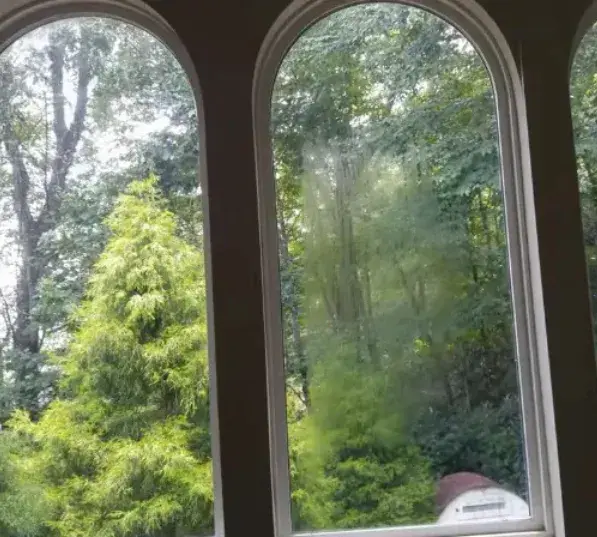
In San Clemente, where tap water runs at 560–680 ppm TDS (Total Dissolved Solids) — averaging 625 ppm across distribution zones — and Pacific salt air is depositing on your glass every day simultaneously, the compound effect is fast and visible. A tap water clean on an ocean-view Pier Bowl property can look hazy within five days. A deionized water clean on the same property holds three to five times longer. The difference isn’t the cleaner’s skill. It’s the water.
Call (949) 408-1235 — experiencing the one-week haze cycle? That’s a tap water problem. We fix it.
The Core Difference — Side by Side
Main Points | Tap Water Cleaning | Deionized Water Cleaning |
TDS level | 560–682 ppm (San Clemente Zone 1, avg 625 ppm) | Below 5 ppm |
What dries on your glass | Dissolved calcium, magnesium, sodium | Nothing — pure H₂O dries completely clean |
How it looks immediately after | Clean and clear | Clean and clear |
How it looks after 5–7 days | Mineral haze visible, especially in raking light | Still clear — only environmental contamination builds |
How it looks after 2–3 weeks | Significant haze, often back to pre-clean appearance | Moderate accumulation from salt air only |
Streaking risk | High — requires squeegee technique to minimize mineral streaks | None — water left to dry spot-free |
Frames and sills | Minerals deposit in channels and run back onto glass | Pure water clears channels without adding mineral residue |
On coastal glass with salt | Compounds with salt — two contamination sources | Eliminates the cleaning-water source, leaves only environmental salt |
Cost | Same or lower per visit | Same pricing — DI water is our standard, not an upgrade |
Deionized water is standard on every visit. No upgrade required.
Why San Clemente Tap Water Is Particularly Hard
Not all tap water is the same. A window cleaner using tap water in Seattle — where the water runs 30–50 TDS from snowmelt sources — is depositing a fraction of what a cleaner using San Clemente municipal water deposits. San Clemente’s water is hard. Very hard.
City of San Clemente municipal water — which serves most of the city including Downtown, Forster Ranch, Marblehead, Rancho San Clemente, and Central San Clemente — is recorded in the City’s 2025 Water Quality Report at an average TDS of 625 ppm, with a range of 560–682 ppm across distribution zones.
Santa Margarita Water District — which serves Talega — runs similar TDS levels from its blend of imported and local water sources.

At 600 TDS, every liter of tap water used to clean your windows contains approximately 600 milligrams of dissolved mineral content. On a standard two-story home clean using 30–40 liters of water, the cleaning process is depositing 18,000–24,000 milligrams of minerals onto your glass and frames — invisible until the water evaporates. That’s before the Pacific salt air deposits anything.
The compound math in San Clemente: A Pier Bowl property that gets cleaned with tap water ends up with two contamination sources working simultaneously:
- The cleaning water’s mineral residue (deposited by the cleaner)
- Daily Pacific salt deposition (deposited by the environment)
A Pier Bowl property cleaned with deionized water at sub-5 TDS ends up with one contamination source:
- Daily Pacific salt deposition (deposited by the environment)
The result is a clean that holds between two and five times longer — not because deionized water repels salt, but because it eliminates one of the two contamination sources entirely.
San Clemente’s hard water is why we use DI on every job. No exceptions.
How Tap Water Creates the “Haze-Back” Cycle
The pattern San Clemente homeowners describe most often when calling us for the first time: “We had the windows cleaned. They looked great. A week later they were hazy again. We thought it was the salt air. Then we had them cleaned again. Same result. We’ve been on a monthly cleaning schedule, and they never seem to really stay clean.” Here’s what’s actually happening in that cycle:
Time Period | Condition | Explaination |
Day 1 | Clean looks perfect | The tap water is still on or just off the glass. The mineral content is dissolved in the water and invisible. The glass looks clean. |
Day 2–3 | First drying | The water has evaporated. The dissolved minerals have crystallized on the glass surface as a thin invisible film. The glass still looks clear in most lighting. |
Day 4–5 | Salt deposits on top | Pacific salt air has been depositing on the glass since the minute the cleaner left. The mineral film from the tap water is now bonding with the salt film from the environment. |
Day 6–7 | Raking light reveals it | In afternoon sun hitting the west-facing glass at an angle, the compound film of cleaning-water minerals plus environmental salt scatters light and creates the visible haze. The glass looks like it wasn’t cleaned. |
Week 2–3 | More salt, more irrigation | The irrigation system has cycled twenty-plus times since the clean, depositing additional calcium on lower-floor glass. The compound mineral layer is now building toward what it was before the clean. |
Month later | Back to baseline | The glass effectively looks the same as before the clean. The cycle repeats. |
What deionized water does to this cycle: It eliminates Step 2. There’s no cleaning-water mineral film to provide a base layer for the salt to bond to. The salt still deposits — that’s the environment. But it’s depositing on clean glass rather than on a pre-existing mineral layer. The salt film that builds over a few weeks on DI-cleaned glass is lighter and easier to clear on the next visit. The intervals between effective cleans extend significantly.
Stuck in the monthly cycle? Call us. One visit with DI water shows the difference.
Where Each Method Is Actually Appropriate
Deionized water is the right tool for exterior glass in a hard-water coastal environment. But there are situations where traditional methods still make sense — and being honest about that matters.
Deionized water is best for
- All exterior glass in San Clemente — the combination of hard tap water and coastal salt makes DI the only method that holds meaningfully between visits
- Upper-floor glass via water-fed pole — the pole system delivers DI water to second-story glass without any ladder contact with patio covers or rooflines
- Frames, sills, and channels — pure water rinses channels without depositing mineral residue that would run back onto the glass
- First cleans with significant salt film — the brush agitation of the water-fed pole physically breaks salt bonds from the glass surface while the DI water rinses it clean
Traditional soap and squeegee is best for
- Interior glass — inside the home, you control the environment. Traditional squeegee technique with a professional applicator and appropriate solution works well on interior glass where the drying conditions are controlled, and there’s no ongoing salt deposition
- Specific glass types or situations where the water-fed pole isn’t the right tool — some architectural glass features, some interior transoms, some situations where access or glass type makes the pole inappropriate
Our approach on every San Clemente job
Exterior glass with deionized water and the water-fed carbon fiber pole. Interior glass with traditional spray bottle and squeegee technique. This is the combination that produces the best results on coastal California homes.
Exterior DI water, interior traditional technique. The right tool for each surface.
The Long-Term Damage Angle — What Tap Water Does to Glass Over Time
The haze-back cycle is the short-term problem. There’s a longer-term issue that matters more for San Clemente homeowners in the $1.5M–$3M+ market. Repeated tap water cleaning — especially when compounded with daily irrigation overspray — progressively builds a mineral layer on glass that eventually bonds to the surface itself.
Stage 1 — Surface mineral film
Fresh calcium and magnesium deposits from tap water and irrigation sit on top of the glass. This stage responds to standard deionized water cleaning on the first visit.
Stage 2 — Bonded mineral layer
Over multiple seasons of mineral deposition and sun exposure — San Clemente’s 280–300 days of sunshine bake mineral deposits into the glass surface faster than in cloudier coastal markets — the calcium begins to chemically bond with the silica in the glass. At this stage, deionized water cleaning loosens and removes the surface accumulation but doesn’t fully restore the glass. The bonded layer remains.
Stage 3 — Mineral etching
The bonded calcium layer has become permanent surface damage — the silica of the glass itself has been altered by the acid-base chemistry of the mineral deposit cycle. At this stage, hard water spot removal treatment with specific chemical compounds is required, and even then, the result depends on how deep the etching has penetrated.
Stage 4 — Irreversible glass damage
Advanced etching that has penetrated beyond the surface coating of the glass cannot be chemically removed. At this stage, glass replacement is the only option.
The progression from Stage 1 to Stage 3 takes 3–7 years on a heavily irrigated San Clemente property cleaned with tap water throughout. The progression is slower on properties that have been maintained with deionized water — because DI water cleaning doesn’t add to the mineral accumulation between visits.
The practical implication: Starting deionized water cleaning earlier costs less than hard water spot removal treatment later — and significantly less than glass replacement.
White spots that standard cleaning won’t clear? We assess the stage before we treat
San Clemente’s Water Quality — The Official Numbers
The City of San Clemente publishes an annual Water Quality Report as required by California water utility regulations. The City of San Clemente Water Quality Report archive documents TDS levels by distribution zone. The 2025 report records:
- Zone 1 (City of San Clemente municipal): Average TDS 625 ppm, range 560–682 ppm
- Zone 2 (second distribution zone): Average TDS 545 ppm, range 465–625 ppm
Both zones fall in the “very hard” classification by US water quality standards. For context:
- Soft water (e.g. Seattle, Portland): below 60 ppm
- Moderately hard: 60–120 ppm
- Hard: 120–180 ppm
- Very hard: above 180 ppm

At 560–682 ppm, San Clemente tap water sits three to four times above the threshold for “very hard” classification. It’s among the harder municipal water supplies in coastal Southern California.
This is why deionized water cleaning holds longer in San Clemente than it would in a soft-water city. The gap between tap water mineral content and DI water mineral content is larger here. The benefit of eliminating the cleaning-water contribution is proportionally larger.
sub-5 TDS on every visit. That’s the standard we run against San Clemente’s 600 TDS tap water.
The Bottom Line
Tap water leaves mineral residue on glass when it dries. In San Clemente’s hard-water environment, that residue is significant — and it stacks with the daily salt deposition from the Pacific. The result is a clean that looks right for a few days and hazes back within a week.
Deionized water leaves nothing on the glass when it dries. The environmental salt still accumulates — that’s the coast. But without the compound effect of the cleaning water adding to it, the clean holds three to five times longer.
Every exterior window cleaning visit we run in San Clemente uses deionized water at sub-5 TDS. It’s not an option or an upgrade. It’s the standard — because it’s the only method that actually works on coastal glass with hard municipal water.
Frequently Asked Questions — Tap Water vs Deionized Water
Still have a question not answered here?
Call us (949) 408-1235 — real person, no hold queue, during business hours.