What Does Professional Window Cleaning Actually Include?
Professional window cleaning covers the glass pane, frames, channels, sills, and screen assessment on every window — not just the glass. The distinction matters in San Clemente specifically because salt deposits in frame channels drain back onto clean glass within 24 hours if the channels aren’t cleared, and calcium buildup in sills transfers to the glass during the next irrigation cycle.
The glass is the visible part. What separates a clean that holds from one that hazes back within a week is whether the frames, channels, and sills were addressed alongside the glass pane. Here’s exactly what a professional window cleaning visit includes, what it doesn’t, and what you should ask about before booking.
Call (949) 408-1235 — or read the breakdown first.
Exterior Clean
TDS Check Before Anything Touches Your Glass
Before the water-fed pole goes up, we check the TDS meter. This is a quick verification that the deionized water system in the truck is producing water below 5 TDS — the threshold at which water dries without leaving mineral residue.
San Clemente’s tap water runs at 560–682 ppm depending on the distribution zone. If someone cleans your glass with unverified “DI water” that’s actually reading 150 ppm because the resin is exhausted, the results are essentially the same as tap water cleaning — mineral residue builds when it dries. The TDS check is what ensures the water system is actually working as intended on that specific visit.
We check before every job. If the reading is above 5, we replace the resin before starting. This step takes 30 seconds and is the difference between a clean that holds 10 weeks and one that hazes in five days.
Exterior Glass — Deionized Water, Top to Bottom
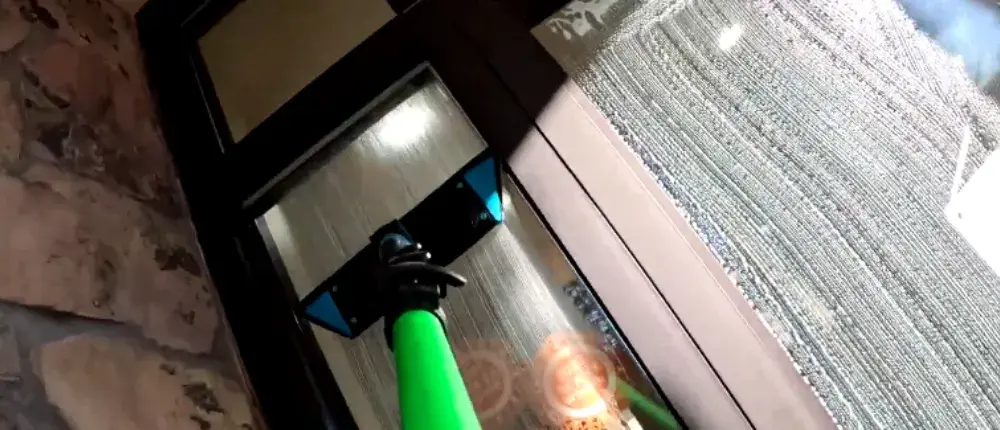
Every exterior pane is cleaned with our DI water at sub-5 TDS through the water-fed carbon fiber pole. The brush head scrubs the glass surface to agitate contamination loose, and the continuous DI water flow carries it off and down the pane. The rinse does the work — there’s no squeegee on exterior glass cleaned with the water-fed pole system.
Top to bottom is the only correct order. Cleaning lower glass first and then rinsing upper glass sends contamination from the top down over already-cleaned panes. Every exterior window is cleaned from the top of that window’s glass to the bottom, with the water sheeting all contamination downward and off the sill edge. Second-story and upper-floor glass reached from the ground with the pole. No ladder on your aluminum patio cover. No contact with clay tile rooflines.
Frames Wiped on Every Window
Every frame surrounding every glass pane is wiped down after the glass is cleaned. This step is the most frequently skipped by budget window cleaners who charge less and spend less time per window — and it’s the step that most directly determines how long the clean holds.
Salt deposits in aluminum frame channels are mineral-rich. When morning marine layer moisture or the irrigation cycle wets the frame deposits, they dissolve and run down the channel onto the clean glass pane below. A window cleaned at 8 am with pristine glass can show frame drainage staining by the next morning if the channels weren’t cleared.
Frame wiping is included on every window on every visit. Not an option, not an add-on — part of the standard process.
Sills Cleared on Every Window
The sill at the base of each window collects the calcium and salt residue that doesn’t fully drain off during cleaning. Leaving the sill dirty after cleaning the glass creates a calcium reservoir that contacts the glass bottom edge with every rain, irrigation splash, or moisture event. We wipe every sill on every window.
On Talega and Forster Ranch properties where irrigation systems run at the base of windows daily, sill clearing is particularly critical. The calcium concentration in the sill after a season of pre-dawn irrigation cycles is significant — more than enough to stain the glass edge and begin transferring calcium back to the pane with the next irrigation event if the sill isn’t cleared.
Screens — Assessed and Cleaned
Every screen removed from the frame, assessed, cleaned, and replaced. Screen assessment means checking the mesh for tears, checking the aluminum corner joints for corrosion, and evaluating whether cleaning or rescreening is the appropriate next step.
At coastal San Clemente positions — Southwest San Clemente, Sea Pointe Estates, Pier Bowl beachfront — screens accumulate salt aerosol in the mesh fibers continuously. That salt holds moisture against the aluminum frame and accelerates corner joint corrosion. Screens that haven’t been professionally cleaned in multiple seasons at these positions often show active corrosion at the corners.
We assess before cleaning. Corroded corner joints are flagged for rescreening and quoted separately before any replacement work is done. We never replace screens without your explicit go-ahead. Screen cleaning is included on every residential visit. Not an extra charge. Not something you have to request.
Interior Clean
Shoe Covers Before Entry
Every interior visit starts the same way: shoe covers on at the threshold, before any entry. The floor your windows sit above — Saltillo tile, hardwood, travertine, stone — stays dry and clean throughout the interior visit. This isn’t a courtesy addition. It’s a professional standard that real operators follow because the alternative — tracking exterior moisture and debris across a homeowner’s floor — is the kind of thing that generates complaint calls and one-star reviews.
Spray Bottle and Microfiber — No Bucket
Interior window cleaning uses a spray bottle of cleaning solution and microfiber cloths. No bucket. A bucket in an interior space is a spill risk every time it’s moved — onto hardwood, stone, or over a windowsill onto furniture. A spray bottle eliminates that risk entirely.
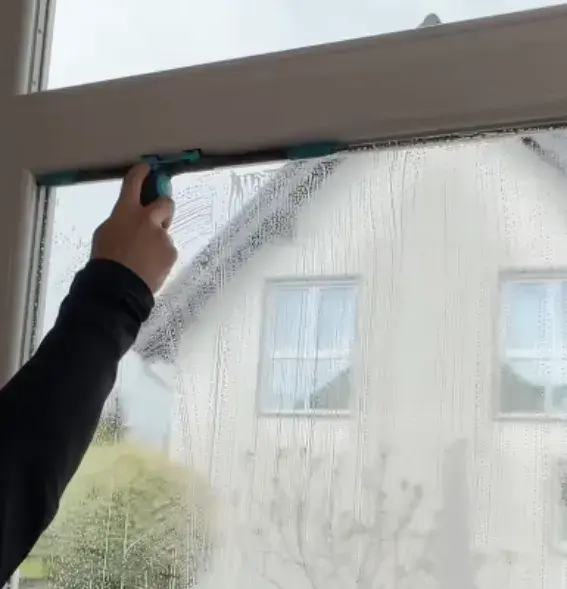
The window applicator (mop) wets the glass with cleaning solution. The squeegee pulls it off in straight pulls with a controlled edge-to-edge technique. A clean lint-free microfiber cloth details the corners and frame edge where the squeegee can’t reach. The cloth must be genuinely clean — a contaminated cloth transfers its prior load to the corner detail and produces streaking at the edges even when the main pane looks good. We use fresh cloths per visit.
Exterior Before Interior
The sequencing matters. Exterior cleaning goes first, interior second. If we clean the interior glass first and then run water on the exterior, any rinse water that gets into the frame channels from the exterior side can transfer back to the interior sill we’ve already cleaned. The correct professional sequence: “You run the exterior first. Then you come inside. That way, if anything comes loose from the frame during the rinse, it’s not landing on interior glass we’ve already done.”
Interior Salt Film on Coastal Glass
In San Clemente beach-adjacent homes — Pier Bowl, North Beach, beachfront properties in Southwest San Clemente — interior glass near operable windows and sliding doors accumulates a light salt film from ocean air entering through openings. Interior glass facing the Pacific at bluff positions can show visible haze from this interior salt deposition on the room-side surface.
The interior clean addresses this. Spray bottle with cleaning solution, microfiber, squeegee — same process as a standard interior clean. The salt film on the interior surface isn’t as heavy as the exterior accumulation, but it reduces the clarity of ocean views from inside the home when it’s left unaddressed. Interior cleaning is part of full-service residential window cleaning visits. Exterior-only visits are also available for homeowners who prefer quicker turnaround or lower cost.
Walk-Through Under Raking Light Before Payment
Every visit ends with a walk-through of all cleaned windows — exterior and interior — under raking light. Raking light means the light hits the glass at a low angle rather than straight on. Raking light reveals any remaining film, streaking, or frame drainage that straight-on inspection misses.
If anything isn’t right, it gets addressed before we pack up and before we invoice. You don’t pay for a clean and then call later about something we missed. The walk-through closes that loop on every visit.
What’s NOT Included in Standard Window Cleaning
Being clear about what isn’t included matters as much as what is.
Gutter cleaning
Window cleaning and gutter cleaning are separate services with separate equipment and processes. We don’t bundle them. We don’t upsell into gutters when you’ve booked windows. If you ask, we’ll refer you to a gutter service.
Pressure washing
Windows are cleaned with DI water through a water-fed brush system. Pressure washing is a separate service for concrete, siding, and decking. The pressure that cleans concrete would damage window seals. Different tool, different purpose.
Glass repair
Cracked panes, failed IGU seals causing internal fogging between panes, and structurally compromised frames are flagged during the assessment walk — but we don’t repair them. We’ll note what we observed and recommend a glass contractor. Cleaning over a cracked pane or a fogged IGU doesn’t fix the underlying issue.
Solar panel cleaning
Completely different surface, different cleaning approach. We don’t include solar panels in window cleaning visits.
The standard scope in the window cleaning industry varies significantly by provider — some include screens and frames, some don’t. In San Clemente specifically, the combination of coastal salt air and hard water irrigation calcium makes the frame and sill component more consequential than in non-coastal markets. A clean that skips frames in San Clemente produces noticeably worse results than the same glass-only clean would in an inland city.
What to Ask Before You Book
Do you check TDS before every job? If a company doesn’t know what TDS is or doesn’t check it, they’re not running a genuine DI water system.
Does the price include frames, sills, and screens? Or are those add-ons? In San Clemente, frames and sills that aren’t cleaned as part of the standard visit mean a shorter-lasting clean regardless of what’s done to the glass.
Do you walk the job with the homeowner before invoicing? A professional who doesn’t offer a final walk-through inspection is assuming the job is done to your standard without checking.
Do you use a water-fed pole or ladders for upper floors? Ladders on aluminum patio covers and clay tile rooflines are both risks to your property. A water-fed pole is the right answer for exterior cleaning at two-story and above.
Call (949) 408-1235 — those are our answers. You can ask us any of the above on the call.