
What Do Professional Window Cleaners Use? (San Clemente Edition)
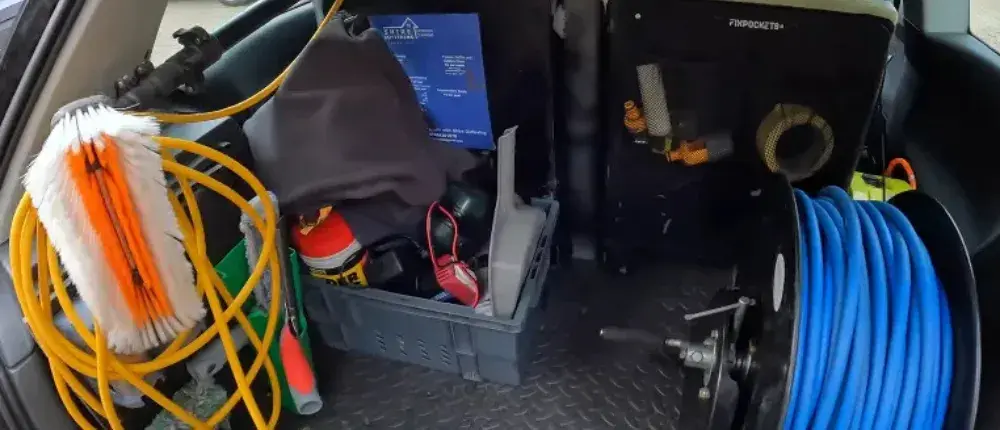
Professional window cleaners use a two-system approach: deionized water fed through a carbon fiber pole for exteriors, and a squeegee with microfiber detail for interiors. On coastal San Clemente glass, the water system isn’t optional — it’s what separates a clean that holds from one that hazes back within a week.
Most homeowners picture a bucket of soapy water and a squeegee. That’s how it worked 20 years ago. The equipment has changed substantially — and in a city where tap water runs at 625 ppm and Pacific salt deposits on clean glass within 48 hours, the equipment change matters. Here’s exactly what we carry and why each piece exists.
Call (949) 408-1235 — questions about our process? We’ll walk you through it.
The Deionized Water System — The Most Important Piece of Equipment
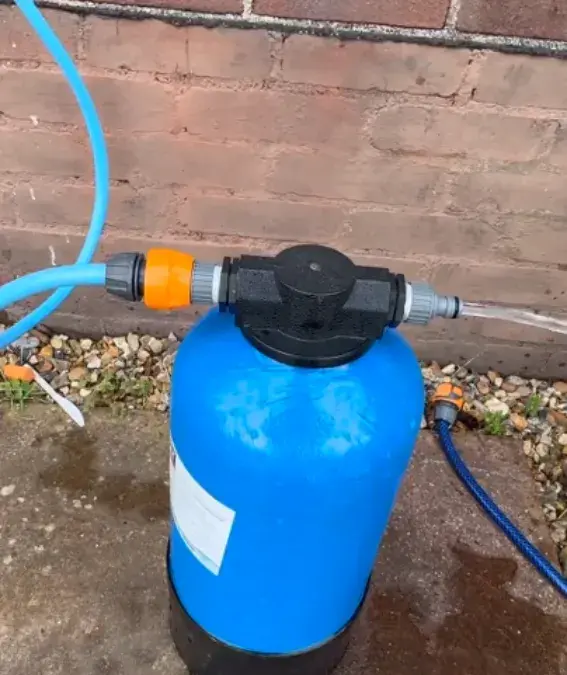
A professional deionized water system runs tap water through two filtration stages before it ever touches glass. First, a reverse osmosis membrane removes the majority of dissolved solids — calcium, magnesium, sodium, and the rest of the mineral load. Second, the water passes through ion exchange resin, which strips whatever the RO membrane missed. The result is water below 5 TDS — Total Dissolved Solids — compared to San Clemente’s municipal supply at 560–682 ppm.
At sub-5 TDS, the water is essentially mineral-free. When it evaporates off glass, it leaves nothing behind. No spots. No film. No mineral residue from the cleaning water itself.
Why does this matter on coastal glass specifically? San Clemente tap water is already very hard. Any cleaner using it deposits a fresh mineral layer on the glass every time they clean — on top of the salt already accumulating from the Pacific. The compound haze-back cycle most SC homeowners describe — windows looking worse two weeks after a clean than they did before — is usually this problem. The cleaning water is making it worse, not better.
The TDS Meter — The Quality Check Before We Touch Glass
Before the water-fed pole goes up, we check the TDS meter. It’s a small digital probe that reads the dissolved solids concentration in the water at that moment. The DI resin has a finite lifespan — it exchanges ions from the water with its own ions until it’s exhausted. When the resin is fresh, the system produces sub-5 TDS water easily. As the resin approaches exhaustion, the TDS reading creeps up. A reading of 10, then 20, then 50 tells you the resin needs replacing.
A professional who doesn’t check TDS before a job either doesn’t know about the check or doesn’t care about the result. If the resin is exhausted and you’re running 200 TDS water through your “DI system,” you’re cleaning with hard water and calling it deionized. The spots come back in days. The homeowner thinks the cleaning didn’t work. We check TDS before every job, every time. If the reading is above 5, we replace the resin before starting. That’s the standard.
The Carbon Fiber Water-Fed Pole
The water-fed pole extends to reach second- and third-story exterior glass from the ground. Carbon fiber poles are the professional standard — they’re lighter than fiberglass, which matters when you’re holding a pole extended to 30+ feet for hours.
The water feeds through the center of the pole from the DI system, exits through a brush head at the top, and both scrubs the glass and rinses it simultaneously. The technique is to brush the glass with the water running to agitate contamination loose, then rinse with a clean flow of DI water that sheets down the pane and carries everything off.
No ladder on your aluminum patio cover. No weight on the clay tile roofline. This is the equipment change that most changed how exterior window cleaning works at two-story San Clemente properties. Before water-fed poles were standard equipment, reaching upper-floor exterior glass meant either ladders on whatever surface was below — aluminum covers, tile, pavers — or leaving it dirty.
The brush head matters too. A flagged bristle brush — bristles with split, flagged tips — holds more water than a straight bristle brush and releases it more evenly on the glass surface. On Forster Ranch and Talega properties where wind patterns from the canyon corridors deposit fine dust on east-facing glass, that even water distribution is what gets the silica and clay particulate off the glass surface cleanly without scratching.

The Squeegee
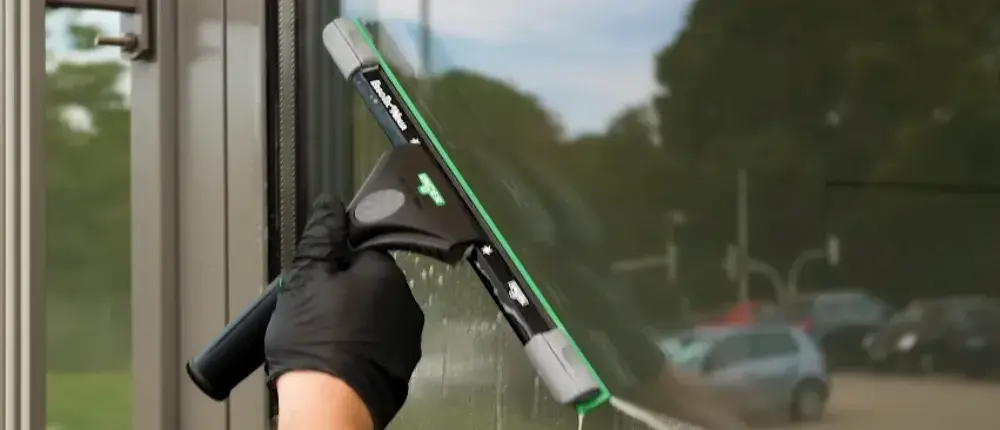
The water-fed pole handles exterior glass. Interior glass uses a different approach. A professional squeegee has a rubber blade in a channel holder, attached to a handle. The rubber pulls the cleaning solution down the glass in controlled strokes. The technique determines the result — “straight pulls with about three inches of gap” is how one experienced window cleaner in California describes it. The gap means the rubber doesn’t skip between strokes. Straight pulls, rather than the arcing fanning technique used by less experienced cleaners, mean no curved water trails at the edges.
For interior cleaning on San Clemente homes, we use a spray bottle rather than a bucket — less water in the room, no bucket to tip over near your furniture. The window mop/applicator wets the glass with cleaning solution, the squeegee pulls it off, and a lint-free microfiber cloth details the corners and frame edges where the squeegee can’t reach. The interior protocol is spray bottle only, shoe covers on, clean from top to bottom. Every window is cleaned from the top frame down so any drips land on glass that hasn’t been cleaned yet, not on finished work.
Microfiber Cloths For Detail Work
After the squeegee, corners need hand detailing. A lint-free microfiber cloth picks up the thin line of water the squeegee leaves at the edge of each pane. The cloth needs to be clean — a cloth that’s picked up even a small amount of mineral residue or dust will transfer it back to the glass when you try to detail with it.
This step is where a lot of amateur cleaning falls apart. The squeegee work looks good, but the corners show water trails or lint from a cloth that wasn’t clean or was the wrong material. Professional microfiber cloths for window detailing are lint-free by design — the fiber structure doesn’t shed.
On interior glass near fireplaces, kitchens, or beach-adjacent openings in Pier Bowl and North Beach homes, we also use microfiber for full interior panes where a spray bottle and cloth are more appropriate than a squeegee — smaller fixed panes, decorative glass inserts, and glass doors with gaskets that a squeegee rubber can’t navigate cleanly.

Screen Cleaning Equipment
Screens are cleaned separately from glass — different tools, different process. For screens with light dust and salt accumulation — common on Talega and Forster Ranch properties where screens aren’t directly blasted by coastal aerosol — a dry brush or soft-bristle cleaning removes most contamination without wetting the screen and causing more dust to stick.
For screens on coastal properties — Southwest San Clemente, Sea Pointe Estates, Marblehead ridgeline — where salt has embedded into the mesh fibers, a wet screen cleaning process with a designated screen cleaner is needed. The screen comes out of the frame, gets laid flat, cleaned on both sides, and reinstalled.
Before any screen cleaning, we assess the frame corners. Aluminum corner joints on screens at coastal positions corrode faster than inland. A screen with a corroded corner joint needs rescreening, not cleaning — cleaning a structurally compromised screen just delays the inevitable and risks the frame cracking during the process. We flag those before touching them.
What We Don’t Use — And Why
No dish soap
Dish soap leaves a surfactant residue on glass that attracts dust and salt particles faster than bare glass. On coastal San Clemente glass that’s already accumulating salt daily, soap residue accelerates the haze-back cycle. Some window cleaners add a small amount of professional-grade window cleaning solution to their wash water for interior cleaning — that’s different from dish soap and doesn’t leave the same residue. For exterior cleaning with the DI system, no soap at all — pure DI water is the entire cleaning medium.
No Windex
Windex contains ammonia, which can damage rubber window seals, tinted film coatings, and some specialty glass treatments over repeated application. It also leaves a cleaning agent residue on the glass surface. Professional window cleaners stopped using ammonia-based household products years ago.
No pressure washing on glass
Pressure washing forces water into frame seals at high velocity, can crack older single-pane glass, and strips weatherstripping on sliding doors. It’s the right tool for concrete and siding — wrong tool for glass.
No ladders on patio covers
Aluminum patio covers aren’t rated for human weight. Walking on them dents the panels and can crack the aluminum at the support joints. The water-fed pole from the ground is the solution — not a ladder on the cover.
The International Window Cleaning Association (IWCA) maintains professional standards for window cleaning equipment and safety practices, and the equipment list above aligns with those professional standards.
Why the Equipment Matters More in San Clemente Than Inland
A bucket-and-squeegee cleaner using tap water produces acceptable results on an inland home in Riverside or Temecula with soft water and no coastal exposure. The same approach on a bluff-front home above Trestles produces windows that haze back within days and calcium deposits that compound season after season.
The tap water vs deionized water difference is most visible in coastal hard-water cities. San Clemente is both — coastal salt exposure and very hard municipal water simultaneously. The equipment stack we run is specifically designed for that combination.
Call (949) 408-1235 — want to know more about our process before booking? We’ll explain every step.