
Why Are My Windows Still Streaky/Smeared After Cleaning?
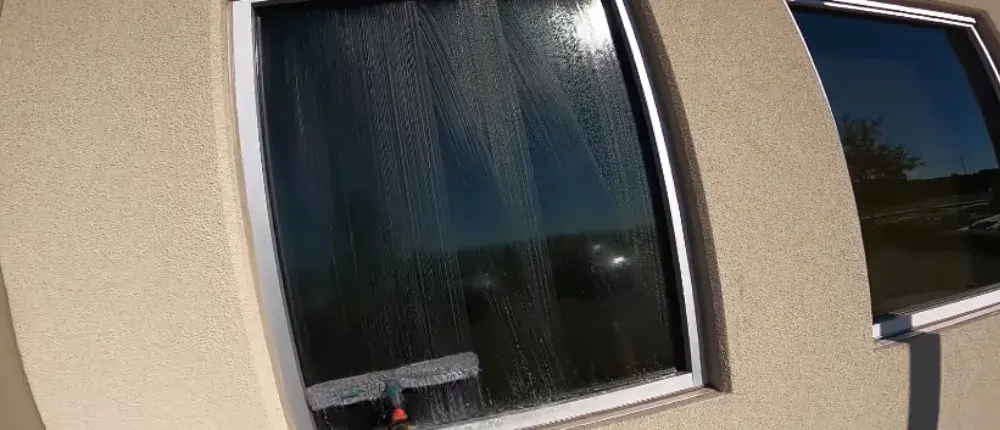
Streaky windows after cleaning almost always come down to one of five causes: tap water mineral residue, soap or cleaning product residue, a dirty or contaminated cloth, frame drainage running back onto clean glass, or cleaning in direct sun. In San Clemente, the first cause is by far the most common — and it’s made worse by the city’s hard tap water. Windows that look smeared after cleaning are often due to cleaning water, soap, or cloth leaving a residue film on the glass surface that becomes visible once it dries.
The good news: every cause on this list is fixable. The bad news: most homeowners and budget window cleaners address the wrong one.
Call (949) 408-1235 if you want the streaking solved properly.
Causes of Streaky/Smeared Windows
Cause 1 — Tap Water Mineral Residue
This is the one that catches most people. They clean their windows, the glass looks good while wet, and within a day or two a hazy film appears. They think the cleaning didn’t work. What actually happened is the cleaning water left mineral deposits when it dried.
San Clemente’s municipal water averages 625 parts per million Total Dissolved Solids. That’s calcium, magnesium, sodium, and other dissolved minerals suspended in the water supply. When you clean glass with tap water — or when a window cleaner uses tap water — the water dries and leaves those dissolved minerals on the surface. The glass was clean for about 30 seconds while it was wet. The moment the water evaporated, the mineral film was already forming.
This is why the windows you just cleaned look worse than expected within a week. The Pacific salt air deposits daily on all exterior glass — that’s the environmental contamination. But the cleaning water is also depositing minerals every time tap water contacts the glass and dries. Both sources compound.
The fix is deionized water. DI water at sub-5 TDS has had the dissolved minerals stripped through reverse osmosis and ion exchange resin. When it dries on glass, it leaves nothing. Only the environmental salt and dust deposit between visits — the cleaning water contribution is eliminated entirely.
In a city with soft water, tap water cleaning produces acceptable results. In San Clemente at 625 ppm, it reliably produces the streaking-after-cleaning cycle most homeowners here have experienced.
If your windows are streaking within days of cleaning, ask whoever cleaned them what TDS their water reads at the tap. If they don’t know what TDS is, that’s your answer.
Cause 2 — Soap or Cleaning Product Residue
Dish soap, Windex, and most household cleaning products leave a surfactant residue on glass after cleaning. The glass looks streak-free immediately after cleaning because the surfactant is still wet and invisible. As it dries, particularly in San Clemente’s consistent sunshine, the surfactant film becomes visible as a hazy or smeared appearance.
The surfactant residue also attracts airborne particles. Salt aerosol from the Pacific, dust from Santa Ana wind events, pollen in spring — all of it sticks more readily to a surfactant-coated surface than to bare, clean glass. Windows cleaned with dish soap or Windex are hazy faster than windows cleaned with pure water because the cleaning product has left a particle-attracting film.
Professional window cleaners use either a minimal amount of professional-grade window cleaning solution — not dish soap — for interior squeegee work, or pure deionized water for exterior water-fed pole cleaning. Neither approach leaves the surfactant residue that dish soap or ammonia-based products leave.
Ammonia — the active ingredient in Windex — also degrades rubber window seals and can damage tinted film coatings on glass over repeated application. On newer San Clemente homes with Low-E glass coatings, Windex is specifically not recommended by glass manufacturers.
Cause 3 — Dirty or Contaminated Cloth
A microfiber cloth that has already picked up mineral residue, dust, or a previous cleaning product will transfer that contamination back onto the glass every time it’s used. The cloth looks clean — it’s dry, there’s no obvious dirt on it — but the previous session’s mineral and residue load is in the fibers.
This is most visible on the corner detailing step after a squeegee clean. The squeegee does most of the work on the large pane. The cloth handles the edge and corner water lines. If the cloth is contaminated, the corners streak even when the main pane looks good.
What to do: Use a fresh, lint-free microfiber cloth for every interior window cleaning session. Wash window cleaning cloths separately from other laundry — fabric softener contaminates microfiber and reduces its ability to pick up glass residue. If you’re detailing corners and seeing streaks in areas the squeegee didn’t touch, the cloth is the problem.
Cause 4 — Frame Drainage
This one is specific to exterior window cleaning, and it’s extremely common in San Clemente. Window frames and channels accumulate mineral deposits from hard water irrigation and salt air. When a window cleaner cleans the glass but doesn’t clear the frames, channels, and sills, those deposits remain in the frame. The next morning’s irrigation cycle or marine layer moisture wets the frame deposits, and they drain down the channel onto the clean glass pane. Within 24–48 hours of a professional clean, the lower portion of each window shows a new mineral trail from the frame drainage.
The homeowner thinks the cleaning was poor. The cleaning may have been technically correct — just incomplete. Glass-only cleaning without frame and channel clearing is fast and cheap. It also produces streaking that appears within days of the visit on every property with active irrigation adjacent to windows.
Every visit we do includes frame wiping, channel clearing, and sill cleaning on every window. It adds time to the job. It’s also what separates a clean that lasts from one that hazes back immediately.
Cause 5 — Cleaning in Direct Sunlight
San Clemente gets roughly 280–300 days of sunshine per year. Cleaning exterior windows in the middle of the day in August when direct sun is hitting the glass is one of the fastest ways to produce streaks regardless of technique or water quality.
Direct sunlight causes the cleaning water to evaporate faster than the squeegee or water-fed pole can clear it. The evaporation rate outpaces the rinse, leaving partial mineral deposits — or partial soap deposits if soap is involved — in a streak pattern where the water dried mid-pane.
Professional window cleaners start early. On bluff-front properties in Southwest San Clemente or Sea Pointe Estates with direct western exposure, morning visits on west-facing glass avoid the afternoon sun problem. East-facing glass can be done earlier in the day before the sun reaches it directly. If you’re doing DIY exterior cleaning, do it in the morning or on overcast days. June Gloom mornings in San Clemente are actually ideal for DIY exterior cleaning — the marine layer provides natural shade before 10 am.
The Difference Between Streaks and Hard Water Spots
Worth distinguishing, because the fix is different:
Streaks
Linear patterns, usually in the direction of water flow or squeegee movement. Caused by the five factors above. Responsive to proper cleaning technique and DI water.
Hard water spots
Round or irregular white mineral deposits, usually more prominent on lower-floor glass near irrigation zones. These are calcium deposits that have dried and bonded to the glass surface through repeated deposition. Standard cleaning removes fresh surface calcium. Calcium that has bonded through multiple irrigation seasons needs hard water spot removal treatment — different chemistry, different process.
If your windows have both streaks and white spots that won’t shift with standard cleaning, the spots are a separate problem from the streaking. The streaking is likely tap water or product residue. The spots are bonded calcium.
According to the EPA WaterSense program, water hardness above 120 mg/L is classified as hard — San Clemente at 625 ppm is more than five times that threshold. The mineral content driving San Clemente’s hard water spots is the same mineral content driving the tap water streaking when non-DI cleaning methods are used.
Why San Clemente Windows Streak Faster Than Inland Cities
Inland cities with soft water — parts of Los Angeles, most of the Bay Area — don’t have the same tap water streaking problem because the dissolved mineral content in the water supply is much lower. A window cleaner using tap water in San Francisco produces acceptable results that hold for weeks. The same cleaner using the same approach in San Clemente produces streaking within days because they’re depositing a 625 ppm mineral load with every cleaning water application.
Add to that the Pacific salt air depositing daily on exterior glass and the 300-day sunshine year that bakes any residue faster than it would in a cooler or cloudier climate — and the streaking cycle that San Clemente homeowners describe is fully explained.
The solution isn’t cleaning more often with the same tap water. That just deposits more minerals faster. The solution is switching to deionized water at sub-5 TDS, clearing frames and channels on every visit, and using no soap or ammonia products on exterior glass.
Call (949) 408-1235 — if your windows are streaking after cleaning, we’ll tell you which cause on this list is producing it.